
Domitian’s Black Banquet
As we in the United States enter this spookiest of seasons, we recount the story of the dinner party the Emperor Domitian hosted with the apparent purpose of terrifying his guests.
Domitian, who ruled from 81 to 96 C.E., is portrayed by the ancient sources as a paranoid and brutal tyrant, although modern scholarship questions whether Domitian is entirely deserving of the opprobrium heaped on his legacy.
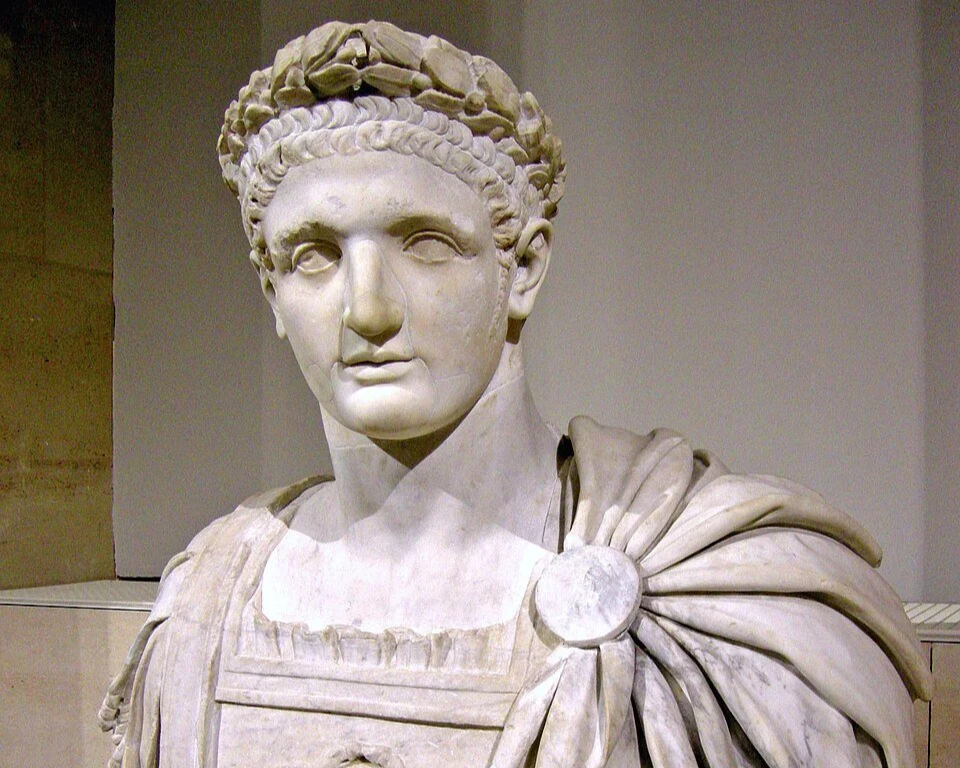
Marble bust of Domitian (original head, body added in the 18th century), The Louvre, Paris.
Some Quick Historiography
Our narrative sources were written exclusively by members of Rome’s political elite, which had a pretty firm idea of what made emperors good or bad. Emperors who showed deference to Rome’s republican traditions and ruled in concert with the Senate were worthy of praise. Emperors who flaunted—rather than tastefully hid—their authoritarianism, sought to erode senatorial authority, and executed senators could expect less glowing accounts of their reigns. Domitian seems to have ticked all of the “bad emperor” boxes, and so his reputation suffered in the later works of Suetonius, Tacitus, and Cassius Dio, who seem to revel in the nasty things they have to say about him.
One of the more colorful—pun intended—stories about the reign of Domitian comes from Cassius Dio (who coincidentally appears as a minor but relevant character in Slaves to Fortune): the infamous Black Banquet.
As a former historian, I feel I must offer the disclaimer that Dio’s account should be taken with a grain of salt, not simply for its senatorial bias, but also because Dio wrote more than a century after the fact and because his is the only source to describe it.
As an aspiring novelist and humble blogger, however, I feel the story—with just a little artistic license—is too good to leave unrecounted.
The Black Banquet
Domitian’s guests, all eminent senators and wealthy equestrians, arrived at the imperial palace in their carriages and litters just as the sun was setting behind the Janiculum Hill. Imperial attendants came forward to admit the emperor’s esteemed guests, but informed them that their usual slave retinues must remain in the vestibule.
The evening’s entertainment was solely for the noblemen’s senses to enjoy.
Already disconcerted by the prospect of a meal with the famously mercurial Domitian and unsettled by this extraordinary directive, the diners allowed themselves to be ushered into the depths of the palace. Farther and farther in they were led, so that the failing light of day could no longer penetrate, and they could see only by the dim light of oil lamps.
Finally, they reached a pair of double doors beyond which, they had to imagine, lay one of the palace’s banquet halls. Two imperial slaves took hold of the handles and swung the doors open to reveal…
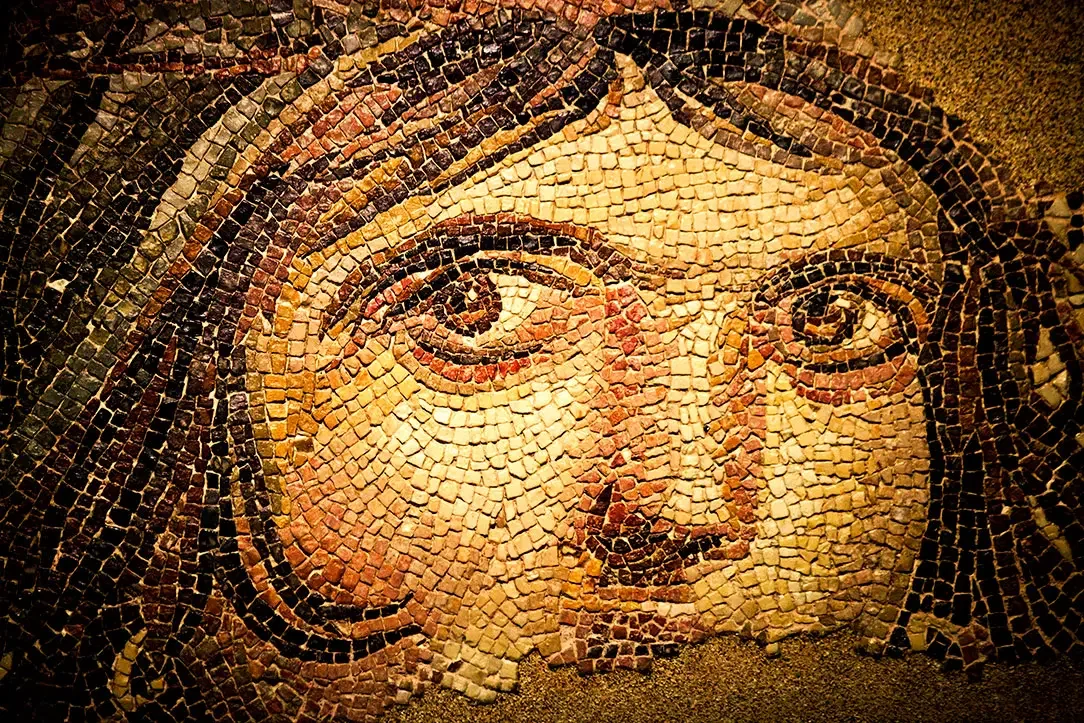
Gypsy Girl Mosaic (ca. 2nd—3rd century C.E.), Zeugma Mosaic Museum, Gazientep, Turkey.
Nothing.
Blackness.
It took a moment for their eyes to adjust before they realized that the room was painted entirely black. Every wall, the ceiling, even the floor, had been daubed a flawless, uniform, unbroken black. The night of the new moon could not be darker than the inky void before them.
With low bows and deferential—if insistent—encouragement, the imperial slaves conducted their charges into the pitch-black dining room. Without the benefit of lamps, they could not see where to go, and so were entirely reliant upon the emperor’s slaves to lead each to his appointed place. For a time all that they could perceive were slow, tentative footfalls and muffled shifting as the diners situated themselves upon their couches.
Then there was silence—but for the private pounding of their hearts.
They started at the snap of metal on rock and their vision went white at the sudden flash of sparks. When they blinked away the glare, they saw that a small flame had been lit, which, in the overwhelming blackness of the room, seemed to bob in thin air. The flame reared and flared, larger and larger, and then divided itself into a dozen, a score of smaller individual tongues of fire that circulated all around the room. It was only when the flames approached that the guests could see that each burned at the end of a taper carried by a slave, who leaned slowly forward to light a small lamp beside each diner. With a final bow, but no words, the slaves stepped back and took their leave.
The guests did not speak, but now they could at least observe their surroundings. The couches upon which they reclined, like the room around them, were black, covered as they were by raven-colored linens. More than one diner had bumped against something hard and cold when coming to rest on his couch. By the light of the lamps, they could see that beside each of them stood a silver slab in the shape of a grave marker. Gasps sounded in the darkness as the diners leaned forward, squinting, to read their own names inscribed into the metal. Even the lamps, they realized, were not ordinary lamps, but the sort that hung in the tombs of the dead.
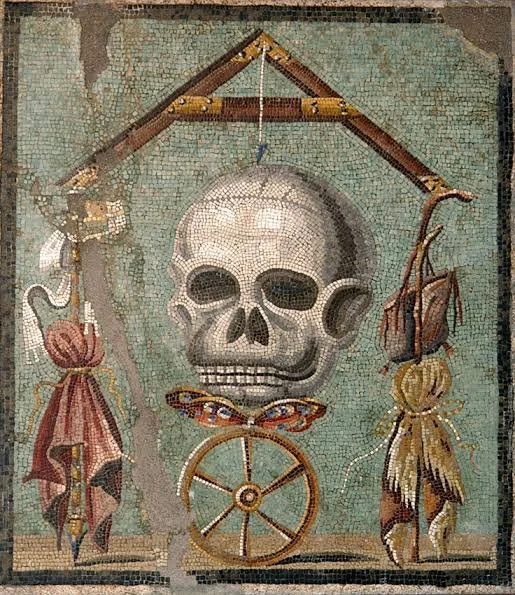
Memento Mori Mosaic (1st century B.C.E.—1st century C.E.), Museo Archeologico Nazionale di Napoli.
Wide eyes gleamed with terror in the low, shuddering light. Their worst fears were being realized. The emperor meant to kill them, every one of them. But not for him the formality of a death warrant, the finality in the swing of the executioner’s blade. No, he would torment them first. Force them to confront death before it came to snatch them away. Some of them turned their heads back and forth, seeking in the dark for the blades they knew at that very moment were coming for their throats. Some prayed in hoarse whispers for the gods to have mercy. Some just moaned.
CRASH
The diners jumped—some cried aloud—at the thunderous clash of cymbals and the padding of bare feet on the floor. Torches erupted in the corners, driving away some of the darkness to reveal in the center of the room a score of dark figures frozen, contorted in agonized poses.
Again the cymbals clashed, and then a shrill strain of pipes and the quivering cords of a lyre and the figures began to move, began…to dance?
They moved like phantoms, amidst and around the diners, flitting through the darkness like bats. And yet their movements were in time with the haunting melody, like some perverse musical parody of dead souls in Hades.
Perhaps a few of the diners—those not completely consumed by terror—had the presence of mind to realize that these were not malign spirits but boys. Naked boys coated, like everything around them, in black. Their painted bodies shone like obsidian as they twisted and leapt to the otherworldly music, which rose, louder and faster, into a frantic crescendo that crested with one last, echoing crash of cymbals that froze the dancing boys as though made stone by the Gorgon’s gaze.
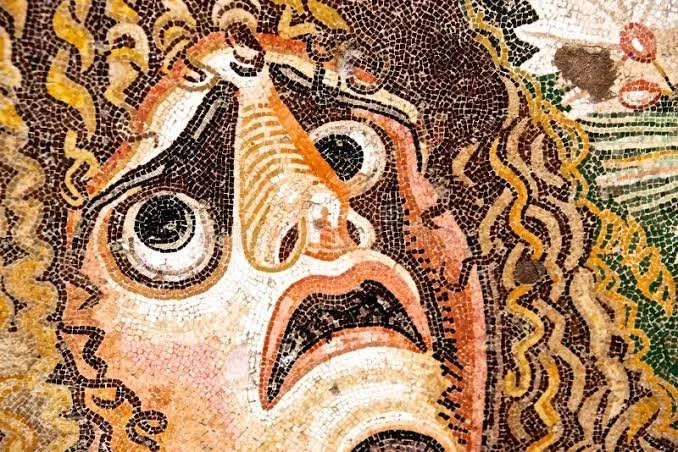
Mosaic depicting a tragic theatrical mask (1st—2nd century C.E.), Capitoline Museums, Rome.
The astonished silence that followed was broken by a single pair of hands clapping.
Domitian had entered the dining room unseen and now warmly applauded the dancers, who bowed, first to the emperor and then to the dumbfounded guests, before scattering throughout the hall to assume their stations beside the couches. Several of the guests rushed to add their own applause to the emperor’s as he took his place on the high couch and the dishes of the gustatio, the appetizer course, were brought in.
Any sense of relief the guests felt fled almost immediately when they glimpsed the food.
It was not simply that the plates upon which the food rested, like everything else, were black, or even that the food itself was dyed the same color.
This was not the customary fare of imperial banquets. There were no fried flamingo tongues, no boiled ostrich, no stuffed snails. There were not even dormice baked in honey or oysters dressed in garum.
There were loaves of coarse spelt bread. There were joints of meat, some flame-charred, others boiled. There were bowls of lentils, olives, dried figs, nuts, and, most chillingly of all, black beans. It was simple fare, but its modesty was not what made the diners’ blood run cold. It was the fact that this was the food that the Romans offered to propitiate the shades of the dead.
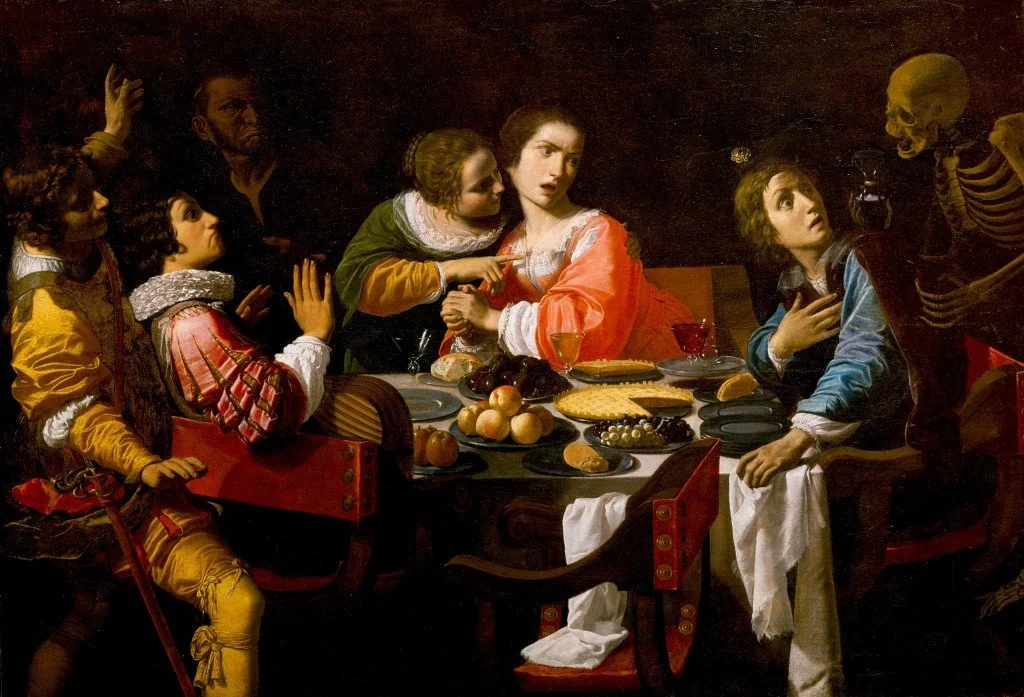
Giovanni Martinelli, La Morte appare al banchetto (ca. 1630—1659), Raclin Murphy Museum of Art, South Bend, Indiana.
And yet, through the whole dinner, Domitian gave no sign of thinking anything was amiss. He addressed his guests pleasantly and solicitously, asking how they were enjoying the food, encouraging them to have a little more—while they still could, he added with an inscrutable grin. He held forth on a wide range of topics—who among Rome’s elite had recently died, the unslavelike bravery of gladiators who perished in the arena, the ideal time of year for slaughtering pigs.
Even the densest among the party could not miss that every topic of conversation returned to the sole theme that had plagued their minds since they had entered the shadowy palace.
Finally, Domitian dismissed his guests, who rose from their couches on trembling legs and forced themselves to walk sedately, rather than run, from the banquet hall. But when they reached the vestibule, they saw that their slaves were gone, nowhere to be found. Instead, they found their litters and carriages manned by other slaves, completely unknown to them, who nonetheless bowed and scraped as good slaves did. When the departing diners asked in shaky voices where they were going, the strange slaves smiled bemusedly and answered, “Why, home of course, master!”
They did go home, but no sooner had they stumbled gratefully inside than they leapt up in sudden fright at a loud pounding on the doors.
This was the moment, they knew. Domitian had waited for them to return home, to relax their vigilance, to think themselves safe. They knew what stood on the opposite side of the door; whether in the form of praetorians or hired assassins, death had come.
What met their eyes when the doors were opened may very well have led more than one to question if the sustained terror of the night had driven him mad.
A grunting slave bustled in lugging a shrouded burden, which he deposited upon the floor and unveiled to reveal the silver tombstone that had marked his couch. Others followed, bestowing upon the thunderstruck man additional gifts: a selection of the plates and bowls from the dinner, which had been cunningly carved from black onyx and were very costly; the black drapery from the dining couch, which, they now saw, was a black mourning toga; a small carving of a skeleton inscribed with the Greek admonition gnothi seauton: know thyself.
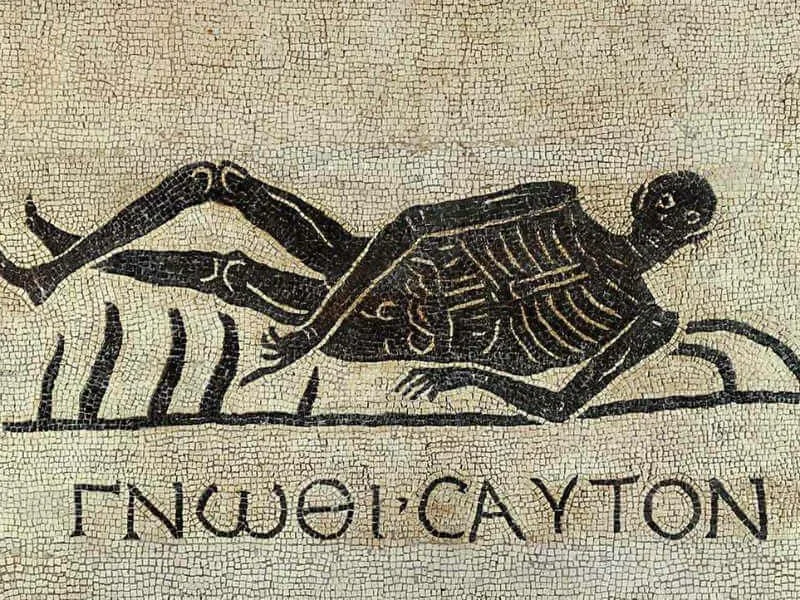
Skeleton Mosaic (ca. 1st—2nd century C.E.), Museo Nazionale Romano, Rome.
The last to enter was the black-painted slave-boy who had attended upon him at the dinner as page and haunting spirit. Only now the paint had been washed away and the shyly smiling boy, one last gift, stood crowned with a wreath of flowers.
And that was it.
Nothing further came of this bizarre ordeal. The guests were not systematically rounded up and executed. Their wealth and status remained unchanged. As far as Dio tells us, it never received further mention.
Again, as discussed above, there is reason to doubt the veracity of the story, or at least some of its more lurid details. But if there is any kernel of truth in Dio’s account, I sincerely doubt that a single one of Domitian’s guests looked at the emperor—or black beans—the same way ever again.