
The Corpse Emperor
Numerian ruled the eastern half of the Roman Empire from July 283 to November 284 C.E. If our source is to be believed, for a fair proportion of that time, he was already dead.
The Crisis of the Third Century between 235 and 284 C.E.—as the name suggests—was not a good time for Rome. The empire was shaken by repeated external invasions, outbreaks of plague, runaway inflation, breakdowns in supra-regional trade, endemic civil wars, and extreme political instability. Perhaps as many as fifty men used military force to claim the imperial diadem, of whom twenty-six obtained official recognition from the Senate. Of the twenty-six “legitimate” emperors, only one is securely attested as having died a natural death. It is for this reason that this period is also commonly known as the Military Anarchy.
The reign of Marcus Aurelius Numerius Numerianus was very much a product of this pattern of imperial dysfunction. Numerian’s father, Marcus Aurelius Carus (282-283), came to the throne after his predecessor, Probus (276-282), was killed in a military uprising. Probus had taken control of the empire from Florian (276), who attempted to succeed his half-brother, Tacitus (275-276)—rocker of history’s most glorious neck-beard—who was either assassinated or perhaps died of a fever. Tacitus was acclaimed emperor after his own predecessor, Aurelian (270-275)…well, you get the idea.
Carus’s Persian War
In the spring and summer of 283, Carus led an army against the Sasanian Persians. Numerian accompanied his father while his older brother, Carinus, held sway in the West. Based on the unreliable and fragmentary sources at our disposal, the campaign appears to have gone well. The Romans swiftly penetrated Persian Mesopotamia and sacked Ctesiphon—the winter capital of the Sasanian kings—and its twin city, Seleucia, across the Tigris River.
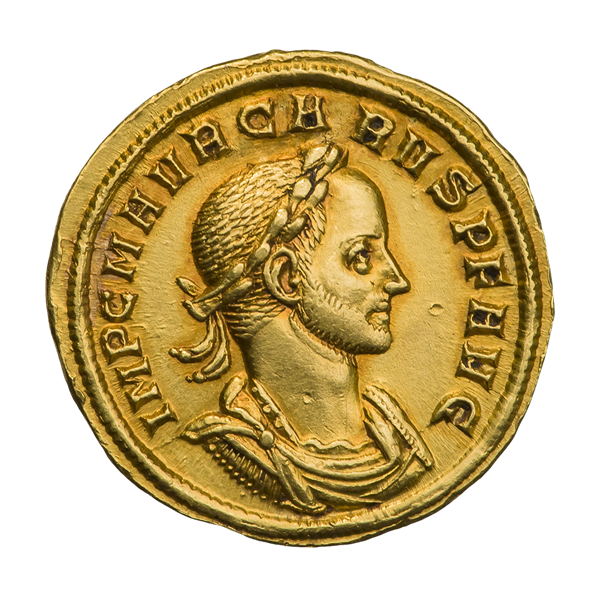
Aureus of Carus (ca. 282-283 C.E.)
Then, in July 283, Carus died suddenly.
Most ancient historians report that the victorious emperor was struck by lightning, an event framed as divine punishment for the hubris of pushing the boundaries of the empire beyond the Tigris, in defiance of the gods. Modern scholars, in their frustrating practicality, disregard this lurid account and conclude that Carus was murdered, fell ill, or succumbed to wounds sustained in battle.
Whatever the case, Numerian was acclaimed full emperor in his father’s place and the army began its long withdrawal.

Portrait head of a young man, possibly Numerian (ca. 3rd century C.E.) Museum of Fine Arts, Boston.
The Historia Augusta
Before proceeding, I must offer the same tired disclaimer that I’m sure my readers are sick of seeing. But in this case, the hedge is more than justified.
We are looking at one of the most poorly attested periods of Roman history, and our most complete narrative source, the Historia Augusta, is notoriously unreliable. This is not a simple matter of temporal distance or senatorial bias. The Historia Augusta, especially where it concerns the period of the Crisis of the Third Century, is so filled with forged documents, absurd gossip, invented sources, and full-on historical hallucinations that some scholars have suggested the work was written as an elaborate parody.
But why should that stop us from having fun with it?
A Boar in the Henhouse
The Roman withdrawal from Persian territory was orderly but slow. By March 284, the army had only reached Emesa in western Syria, where Numerian issued the only known rescript—a formal reply to a petition—in his name.
We do not know exactly how old Numerian was, but his reliance upon his praetorian prefect and purported father-in-law, Lucius Flavius Aper, suggests that he was a young man or at least lacked confidence in his newfound power.
Aper, whose name means “boar” in Latin (this becomes relevant later), took an outsized role in Numerian’s itinerant court, even relative to the many powerful and vigorous praetorian prefects of the third century. Aper issued the marching orders, distributed the day’s watchwords, and dispensed encouragement and largesse among the soldiers. To an uncharitable observer, it might have appeared as though Aper, rather than Numerian, was acting as the emperor. And yet, it was also widely known that Numerian had contracted some form of eye inflammation, quite common in the desert, and was recuperating. At least, that’s what Aper said.
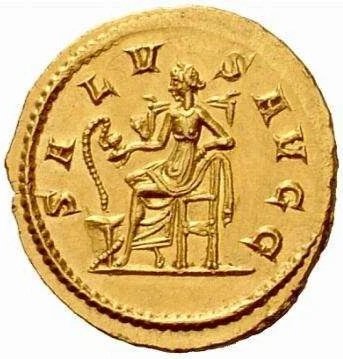
Reverse of an aureus of Numerian (ca. 383-384 C.E.)
Goddess Salus enthroned
Legend: The wellbeing of the Augusti
So no one immediately thought it amiss when, after departing Emesa, Numerian stopped appearing in public.
At night, the imperial pavilion was sealed behind the shields and spears of Aper’s praetorian guardsmen, inaccessible to all but the prefect and his closest subordinates. During the day, Numerian took to traveling in a closed litter. And yet, commands continued to flow from the imperial person, courtesy of Numerian’s loyal and devoted servant, Aper.
There were questions, certainly. These were perilous times, and in perilous times the legions wanted to see their emperor among them. But Aper, smooth and confident, always had an answer, or so we might imagine:
“The emperor must travel this way, to keep his eyes protected from the wind and the dust of the march.”
“The emperor is resting. His cares are many, and it is well known that fatigue can only worsen his ailment.”
“Must we constantly account for ourselves to the common soldiery? Begone! If you want your emperor to recover, cease plaguing him with your constant entreaties!”
A Grisly Denouement
The pretense lasted until November, when the army reached the environs of Nicomedia, modern İzmit on the Anatolian shore of the Sea of Marmara. A party of legionaries strayed closer to the imperial litter than the praetorians should have permitted and, perhaps aided by a providential wind, caught a whiff of something unmistakable.
Mutterings of alarm spread until they became a general hue and cry. The nearest legionaries wrestled the praetorians aside and tore open the curtains.
It was immediately clear that Numerian was dead. But that was not what raised their fury.
These men were veteran soldiers. Many of them had walked battlefields from the Rhine to the Euphrates and everywhere in between. They knew well the look and smell of decay. Numerian’s body bore all of its gruesome hallmarks.
The soldiers realized that for weeks, maybe longer, they had been taking orders from a corpse. And all the while, Aper had kept the secret from them.
Legionaries fell upon the praetorian prefect, bound him with ropes, and threw him in the dirt before the headquarters tent, demanding that a worthy avenger and successor for Numerian be named.
At this point, we meet the most fascinating participant in this peculiar drama: Diocles, a common soldier from Dalmatia who had risen to command the emperor’s elite cavalry guard. He was clever and resourceful, beloved by the soldiers, and entirely ruthless.

Marble head of Diocletian (late third century C.E.), Istanbul Archaeological Museums, Istanbul.
When the question of who must succeed the dead Numerian was put forward, eager voices called for Diocles. He ascended the tribunal before the army and, we are told, received the unanimous acclamation of the soldiers and their commanders.
Now, someone might have asked what role Diocles had played in all this. After all, the commander of the cavalry guard was hardly less an intimate of the emperor than the praetorian prefect. Diocles certainly foresaw that line of questioning, for when the raucous cheering of the soldiers faded, he drew his sword from its scabbard, raised it to the light of the rising sun, and, in a clear, confident voice, swore that he had had no hand in Numerian’s death.
And then he drove the sword through Aper’s body, killing the helpless prefect—before so much as a confession had been wrung from him.
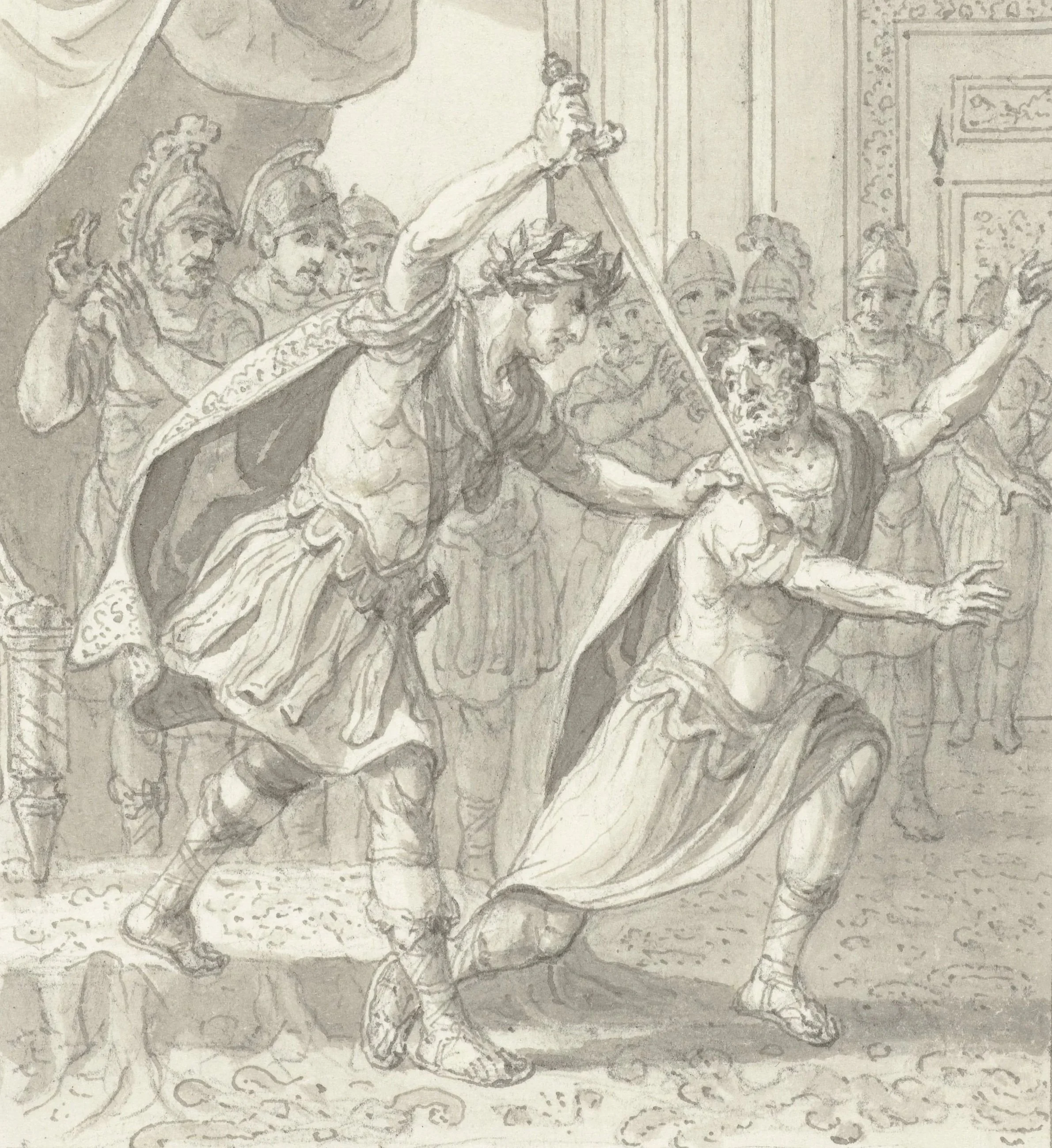
Reinier Vinkeles, Keizer Diocletianus vermoordt Aper (1804-1806), Rijksmuseum, Amsterdam.
A Prophetic Epilogue
I mentioned previously that the etymology of Aper’s name, “boar,” would become relevant later. Later is now.
Diocles wasted no time in cementing his rule, first changing his name to the more Latinate Gaius Aurelius Valerius Diocletianus, or Diocletian, which is how English-speaking posterity knows him best. He also began preparations for taking the army westward to deal with Numerian’s elder brother and last surviving member of his dynasty, Carinus.
Diocletian recognized the obvious contradiction between being hailed as Numerian’s avenger one day and marching against the dead man’s brother the next. So, he had it put out that a druidess had once foretold that he would be acclaimed emperor after he had killed a boar, thus giving his actions divine sanction—up to and including civil war against a rival for power.
If Diocletian truly had no hand in the death of Numerian—and many scholars have concluded that he probably did not, the suspicious timing of Aper’s killing notwithstanding—he could at least make convenient use of the likely culprit’s name.
And so ends the story of Numerian, the corpse emperor, whose absurd death handed the imperial diadem to the man who would end the Crisis of the Third Century and rebuild the Roman Empire.