
Review: “Fire in the East” by Harry Sidebottom
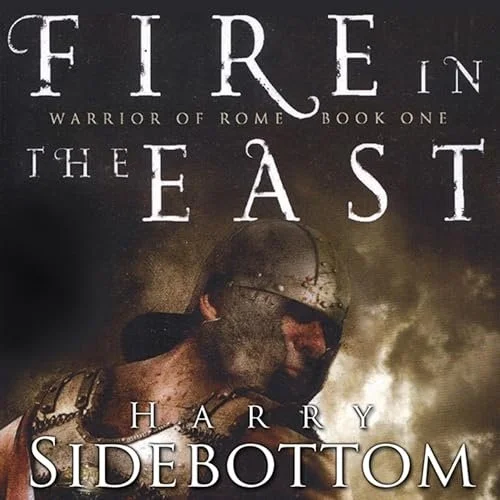
Harry Sidebottom’s premier novel—and the first of his Warrior of Rome series—introduces Marcus Clodius Ballista, the son of an Angle warlord brought to Rome as a political hostage, educated and trained in the Roman fashion, and forced to wage war against the empire’s enemies.
Sent to defend the fictionalized frontier town of Arete, Ballista will face the overwhelming might of the Sassanid Persians and their king Shapur, the prejudice and scorn of his own subordinates, the dangerous factional divides of the town itself, and, finally, treachery from within that could doom Ballista and the people of Arete and open Rome’s eastern provinces to devastation.
Sidebottom, a classicist and lecturer at Lincoln College, Oxford, brings his impressive knowledge of—and obvious passion for—the ancient world to bear in a way that thrusts his readers into the Roman world and worldview without overwhelming them with exposition. He effortlessly weaves the sights, sounds, and especially smells of the ancient experience into his story, and he does not shrink from frankly examining those aspects of Roman society—such as the brutality of chattel slavery and the sheer pervasiveness of physical and sexual violence—that readers will find genuinely distressing.
The character of Ballista is grafted onto the historical figure Balista, or Callistus, an obscure Roman official attested only in a handful of scanty and largely unreliable sources, and his fictional background foreshadows the barbarian soldiers and generals in Roman service that became commonplace in the fourth and fifth centuries. Sidebottom draws significant inspiration for the proceedings of the siege—and some actual, archaeologically-attested incidents—from the historical siege of Dura-Europos. For scholars of the period and avowed history buffs, the drama of Ballista’s siege tunnels strikes with the force of revelation.
Beneath the action, Sidebottom explores questions of identity and belonging through Ballista, a man who is never fully accepted by the people he fights for, as well as through Ballista’s educated Greek slave, Demetrius. Endowed with the sort of education that promises advancement in the Roman Empire—and yet set apart from Ballista and others by his enslavement—his perspective expresses, and embodies, a deep and sympathetic yearning for acceptance.
To the nit-picky reader, Sidebottom’s prose can, at times, feel clinical rather than descriptive, and there are moments when the dialogue and inner monologue feel forced. When compared with his later works, which I have greatly enjoyed, this feels less like an inherent fault in the author’s style than a first-time novelist finding his voice. What always shines through, however, is Sidebottom’s natural, instinctive flair for the sort of action that brings fans of sword-and-sandal fiction rallying to his banner.
When I first read Fire in the East, my initial reaction was, “Now this is historical fiction!” That reaction will be shared not only by readers whose shelves are filled with Simon Scarrow and Conn Iggulden, but also by readers of historical fiction who want to feel genuinely transported to another place and time. Despite the occasional rough edges common to a debut, Fire in the East remains one of the most immersive and intellectually satisfying Roman historical novels I have come across.