
Rome’s Most Underwhelming Emperor
The Emperor Jovian enjoyed an eight-month reign that was distinguished only by a humiliating peace treaty—and an absurdly mundane death.
On June 27, 363 C.E., Flavius Jovianus was acclaimed emperor as a compromise candidate by a Roman army that was on the ropes.
His predecessor was Julian (the Apostate), who spent his short reign trying to stem the rising tide of Christianity and reestablish Paganism as the preferred religion of the empire. In the spring of 363, Julian launched an invasion of Persia that went horribly off the rails—and died of a wound sustained in a minor rearguard action without naming a successor.
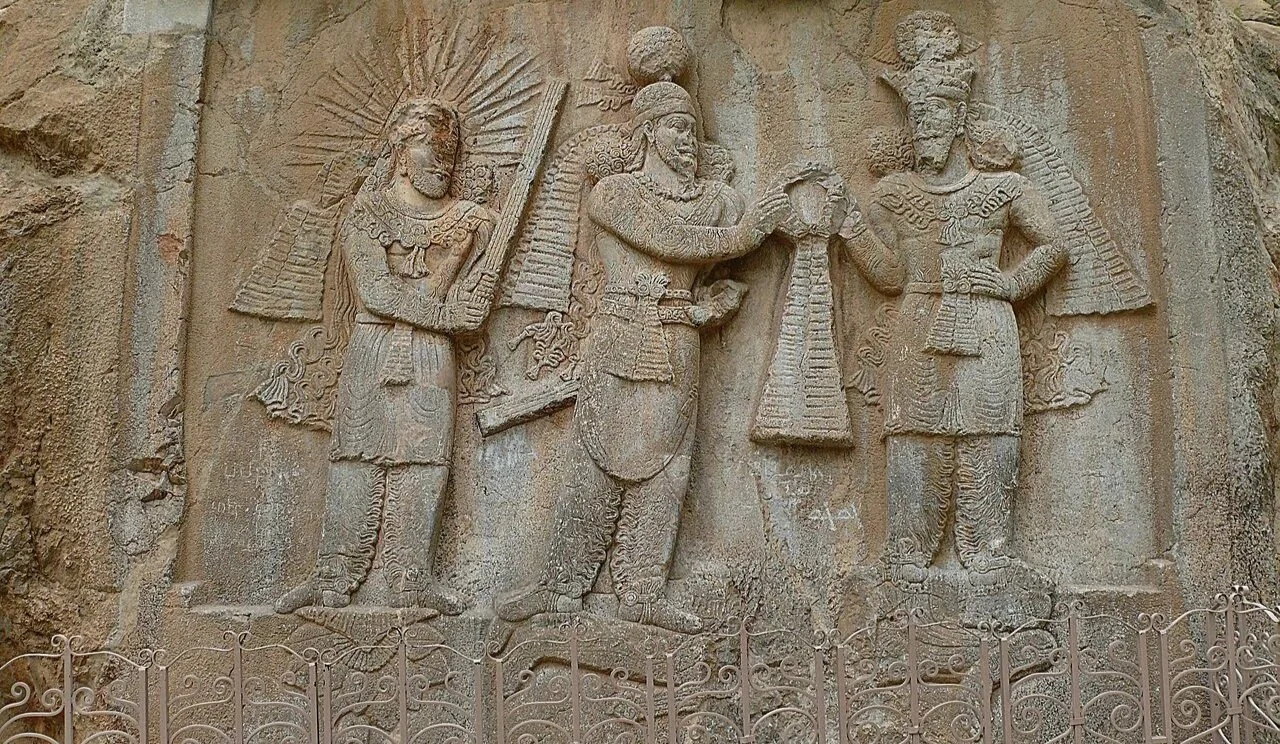
The Coronation of Ardashir II (ca. 379—383), Taq-e Bostan, Iran.
Rock relief depicting Ardashir II (center) receiving the royal diadem from Shapur II (right), with Mithra (left) raising a ceremonial rod. The fallen figure beneath the kings’ feet is to be identified with Julian.
The Roman army was deep in hostile territory, exhausted and ill-supplied, and now leaderless. Selecting a new emperor was top priority.
An Unlikely Emperor
The soldiers first extended the imperial diadem to one of Julian’s chief officials, who turned them down flat, offering as explanation the rhetorically-appropriate Late Antique equivalent of “I’m too old for this shit.”
They next turned to Jovian, a Christian and mid-level officer in the Protectores Domestici, one of the imperial guard units of the Late Roman Empire.
Very little recommended Jovian for the throne other than his apparent inoffensiveness. He was a likable man, who could boast some modest popularity among the common soldiers—mostly derived from the reputation his father had earned as the commander of the Protectores—and he was unacceptable to none of the factional interests that divided the imperial court.
If he was no one’s first choice, he was at least no one’s last choice, and in these straitened circumstances, that was enough.
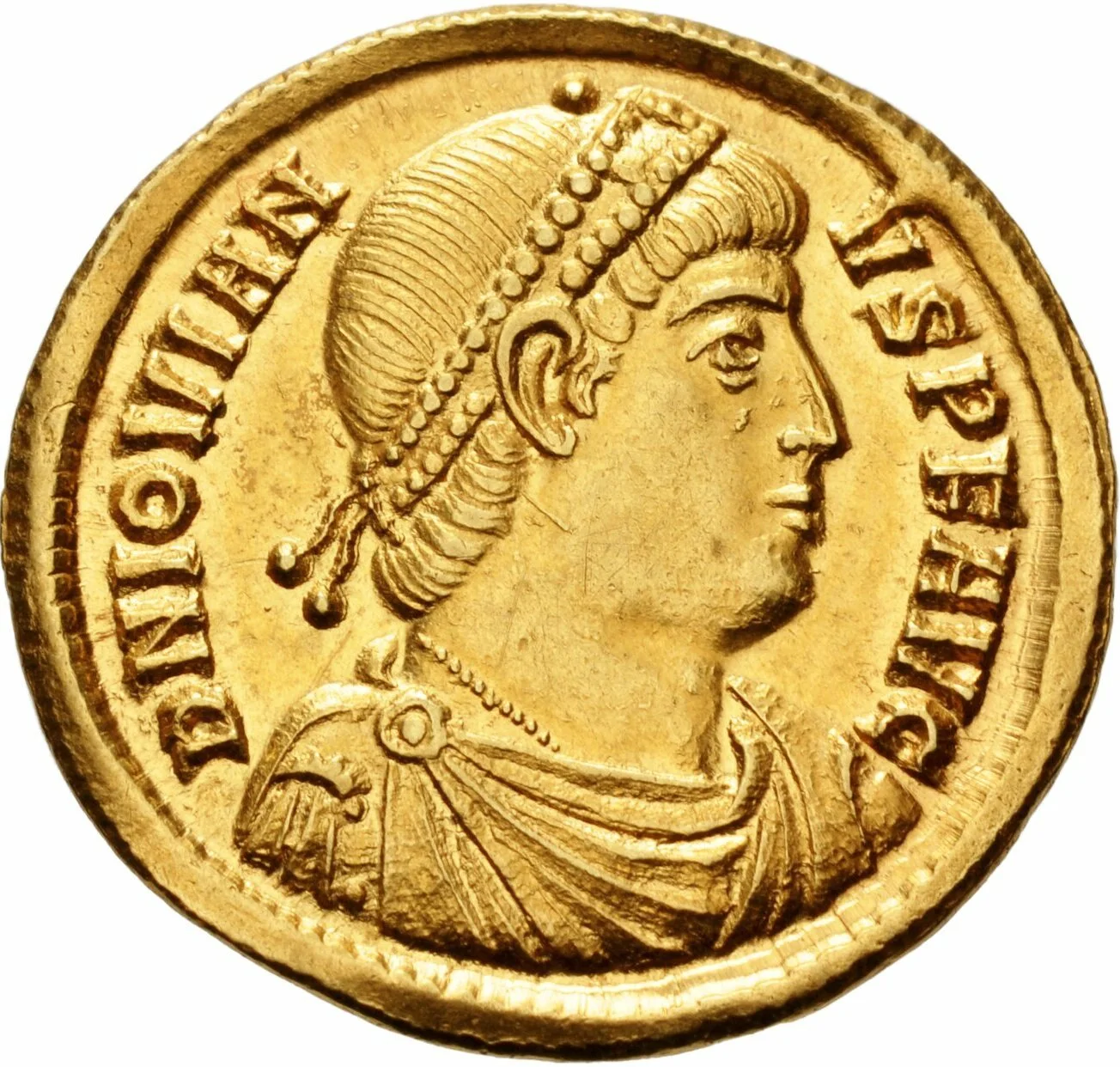
Solidus of Jovian (ca. 363—364)
Bust of Jovian
Legend: Our Lord Jovianus, dutiful and fortunate Augustus
Indeed, he was so obscure that, according to the historian Ammianus Marcellinus—who was present at the event—when the assembled soldiers began shouting “Jovianus!” some of those in the back ranks mistook his name for “Julianus!” and cheered wildly, thinking that Julian had miraculously recovered.
One imagines that the comparatively muted acclamation Jovian received when the soldiers realized their mistake was somewhat deflating.
And matters did not soon improve.
Peace at Any Price
Jovian continued the retreat begun by Julian. The Roman army managed to reach the ruins of Dura-Europos on the Tigris River ahead of the pursuing Persians. There it became trapped—because Julian had burned the river fleet to prevent it falling into enemy hands. When the Persian King Shapur II offered peace on extremely unfavorable terms, Jovian had no choice but to accept. In one fell swoop, he surrendered the lion’s share of Roman Mesopotamia to Shapur and relinquished any Roman claim to influence in the border kingdom of Armenia—a point of contention between Rome and the rulers of Iran for over four centuries.
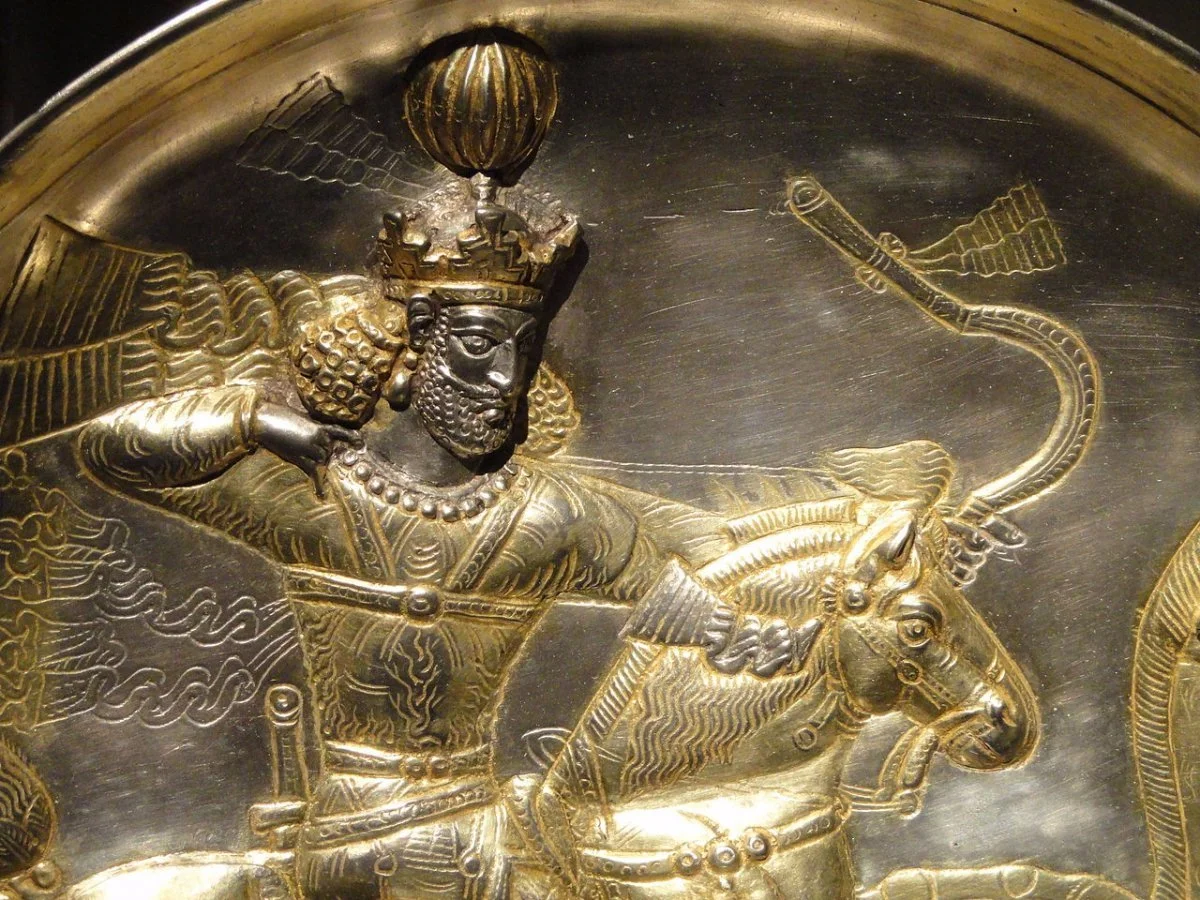
Gilded silver plate, Shapur II hunting wild boar (ca. 4th century), Arthur M. Sackler Gallery, Washington, D.C.
Now, in all fairness to Jovian, it was not his fault that the campaign had gone awry, and it would have taken the military genius of an Alexander the Great—which, sadly for the Romans, Jovian did not possess—to salvage the situation. But fair or not, the opprobrium for this disastrous and disgraceful treaty—the terms of which were relayed throughout the empire at the same time as news of his accession—fell squarely on his shoulders.
Journey Without a Destination
With peace secured and the army returned to Roman territory, Jovian set out for Constantinople with stops along the way to show himself to the people and to handle imperial business.
In September 363, he arrived in Edessa where he issued a couple of edicts and made his most significant contribution to history: reversing Julian’s laws against Christianity. He also dipped his pinky toe into a Christian doctrinal dispute, which was more or less de rigueur for emperors of the fourth century.
In October, he reached the great city of Antioch, where he received a decidedly frosty welcome. The Antiochenes, famously fractious at the best of times, were enraged by the terms of Jovian’s peace deal with Shapur and saw no need to be coy about it. After a month of trying to ignore insulting graffiti and disparaging pamphlets, Jovian departed Antioch under a cloud, possibly ordering the burning of a major library as punishment. By December 363, the emperor was in Ancyra, where he proclaimed his infant son consul for the coming year.
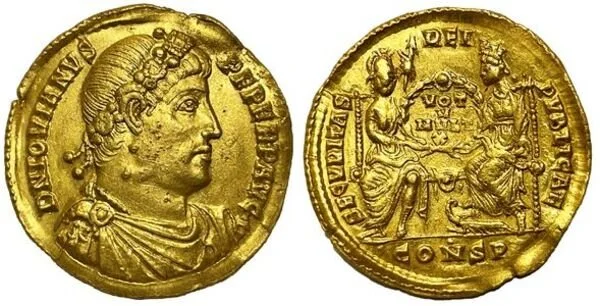
Solidus of Jovian (ca. 363—364)
OBVERSE
Bust of Jovian
Legend: Our Lord Jovianus, Pious and Fortunate Augustus
REVERSE
Rome and Constantinople enthroned, holding a shield
Legend: Safety of the Republic
Jovian’s journey—and reign—ended in Dadastana, a small, nondescript town on the road between Ancyra and Nicaea, on February 17, 364. His servants found him in bed that morning, dead at the age of thirty-three, exhibiting no signs of struggle.
There were the predictable whispers of foul-play—a few sources suggested poisonous mushrooms as the cause of death. But no one close to the emperor seems to have been particularly convinced by those arguments, and they decided not to raise further suspicions by ordering an inquest. They concluded—and modern scholars have largely agreed—that Jovian’s passing was most likely attributable to an unfortunate freak accident: suffocation caused by fumes from a charcoal brazier or a newly-painted chamber wall, or perhaps a combination of the two.
And so, there you have it: the short-lived emperor Flavius Jovianus Augustus. An unexceptional man thrust by the twisted promptings of Fate into exceptional circumstances—and shown to be just about as unexceptional as everyone had expected.
Even his sudden passing in the prime of life seems to have raised little more than a collective shrug.