
Loquamur de Venere, mea voluptas
Let’s talk about Venus—that is, sex—baby.
The popular conception of Ancient Rome tends toward an image of very serious and dry old men preoccupied with very serious, dry matters.
This could not be farther from the truth.
This staid caricature is amplified by the legacy of Victorian scholarship, which was profoundly uncomfortable with just how filthy-minded and sex-obsessed the Romans—and their own contemporaries—actually were.
Don’t believe me? Then I ask you to google Catullus 16, which I hesitate to quote here on the off-chance a young person stumbles across my website and I get an angry email from their parents.
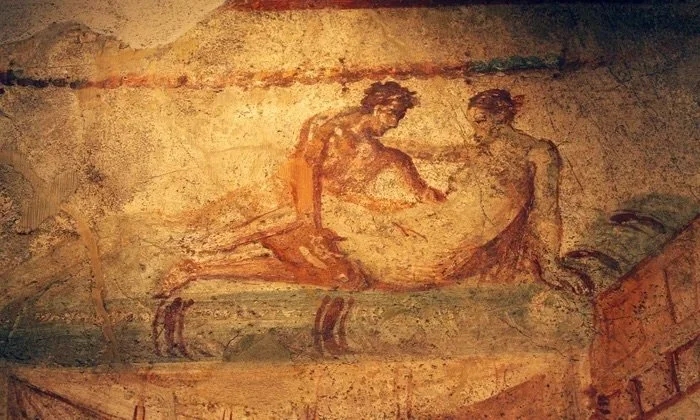
Erotic fresco from the Lupanar (ca. 72—79 C.E.), Pompeii.
But for the Romans, the act of love was not simply about poets hurling violent sexual invective at their literary critics (seriously, check out Catullus 16). Their view of sex was frank and earthy without abandoning sentimentality, and was, at the same time, rigidly hierarchical—in short, it is a microcosm that illustrates a fundamental tension that has always fascinated me about the Romans: the fact that they were just like us while simultaneously being distinctly other.
The Rules of the Roman Bedroom
Perhaps the most disorienting aspect of Roman sexuality for modern observers is the fact that they had no concept of sexual orientation—or “sexuality”—as we understand it today. This does not mean that the Roman sexual landscape was a libertine free-for-all—the other popular misconception of ancient sexuality, given currency by stuffy Roman moralists, early Christian polemicists, and contemporary media.
For the Romans, it mattered far more what you were doing than with whom you were doing it—so, get ready for something that is both dirty and highly technical.
The key divide was between the active and passive roles adopted in the sexual act. The active—i.e. penetrative and dominant—role was to be played by the senior partner; the passive role was to be played by the junior. And these roles were not à la carte; they were determined by Rome’s strict social pecking order. Free, male, adult—active; slave, female, youth—passive.
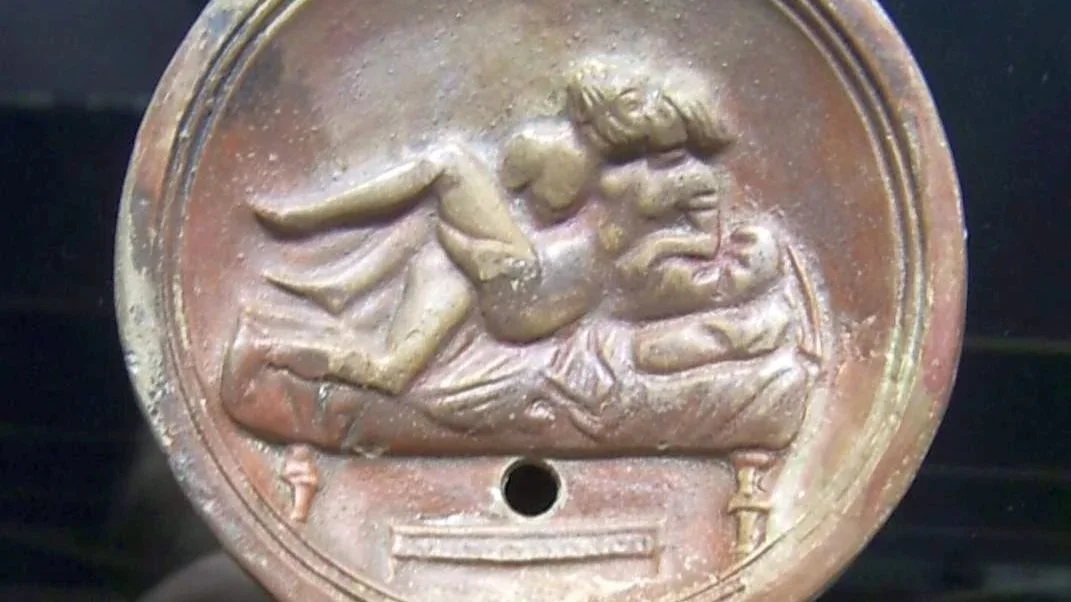
Terracotta oil lamp with erotic motif, Römisch-Germanisches Museum, Cologne.
As far as the Romans were concerned, there was nothing wrong with a grown man enjoying a predilection for young boys—a feature of Roman sexuality for which we share a discomfort with the stodgy Victorian classicists—so long as his chosen partner was not a freeborn Roman citizen and he did not compromise his superior male status in the act. The reputation of the emperor Trajan, who was considered the paragon of imperial excellence, did not suffer for his many pederastic relationships because no one doubted the role he played in the encounters. In sharp contrast, Julius Caesar was dogged throughout his political career by a stubborn rumor that, as a young man, he had submitted (key word) to the advances of the client-king Nicomedes IV—allegedly in exchange for the use of the king’s fleet.
In a Power Dynamic, Someone Has to Hold Power
Equal-status partners were a completely different matter. An explicitly same-sex relationship between two adult men of equivalent status would have been considered unacceptable because at least one would be seen to be disgracing himself by submitting to the other—and taking turns would only make matters worse.
Women could sometimes get a pass here, mostly as a result of male ignorance, which concluded that sex without a penetrative component was not sex at all and was, therefore, not worth dissecting. But there are still several sources that denounce female same-sex relationships—not because of mutual submission, but rather because of perceived female dominance.
In two epigrams, the poet Martial depicts the figure of Philaenis of Samos—either a real person or a persona adopted by multiple erotic authors—as a hypermasculine woman who played ball games and wrestled in the dirt like men, and bedded eleven girls per day. And yet, for all that the depiction is intended to be contemptuous, one may be able to detect more than a hint of anxiety beneath the surface…
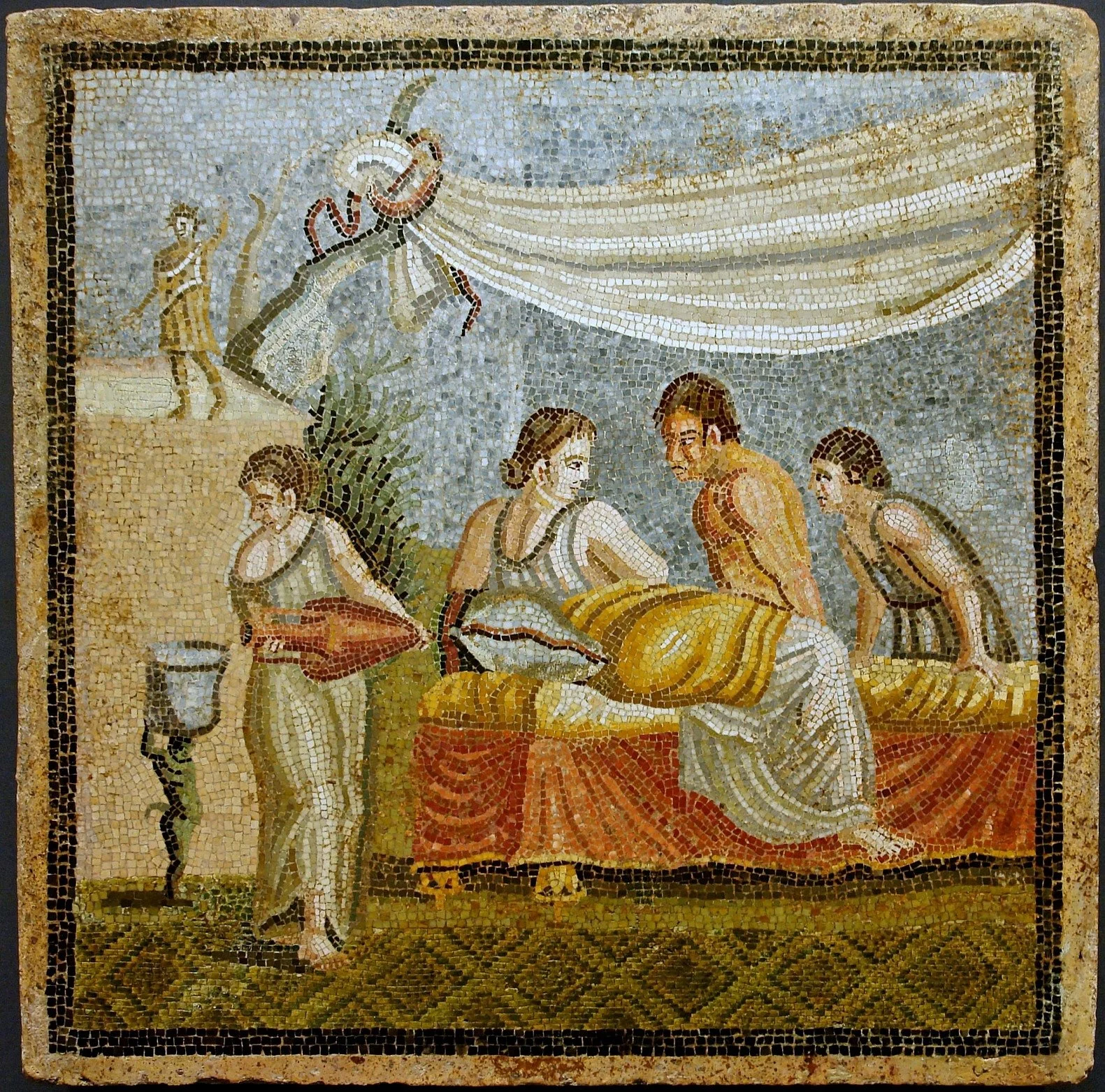
The Love Scene, mosaic (ca. 1st century B.C.E.), Kunsthistorisches Museum, Vienna.
Double Standards and Divine Identities
The severe hierarchization of sex in Ancient Rome made for clear, conspicuous, and—at times—brutal power imbalances.
The disparity between men and women led to at least one major double standard. Female chastity was highly prized, and free women and girls—especially among the nobility—were expected to go to their husbands as virgins.
There was no such expectation of free men and boys. Indeed, they were encouraged to sow their wild oats—so long as no oats were sown into them.
A clear measure of this gender inequality lies in the Roman pantheon. Three Roman goddesses—Vesta, Diana, and Minerva—were explicitly celibate, plus there were at least another three whose purview was chastity, and several others who were responsible for overseeing the loss of virginity on the marriage night.
I invite you to venture a guess at how many deities were responsible for male virginity…
The Brutal Reality of the Enslaved
The most glaring and distressing power imbalance lay between free and slave, and here I shed any wryness of tone.
Legal protections existed to protect freeborn citizen Romans from sexual exploitation—which is not to say that it did not occur. But slaves had no such protection.
Slaves in Ancient Rome were property, pure and simple, and their masters had very, very few restrictions governing how they could utilize their human chattel. Indeed, it was not until the middle of the second century C.E. that killing a slave without sufficient cause was made illegal.
It was very common for masters to sexually exploit their slaves, regardless of age or sex, whether for their own use or for hire. The primary recourse in matters of abuse was the Aquilian Law—and even that belonged to the slaveowner, not the slave, since it covered property damage inflicted by a third party. The slave’s suffering was, legally speaking, immaterial.
It was not as though there were no voices raised in opposition to the practice, but, for the most part, they were raised in reproach of the owner’s lack of self-control. Humanistic protests against the forced debasement of men and women were perishingly rare.
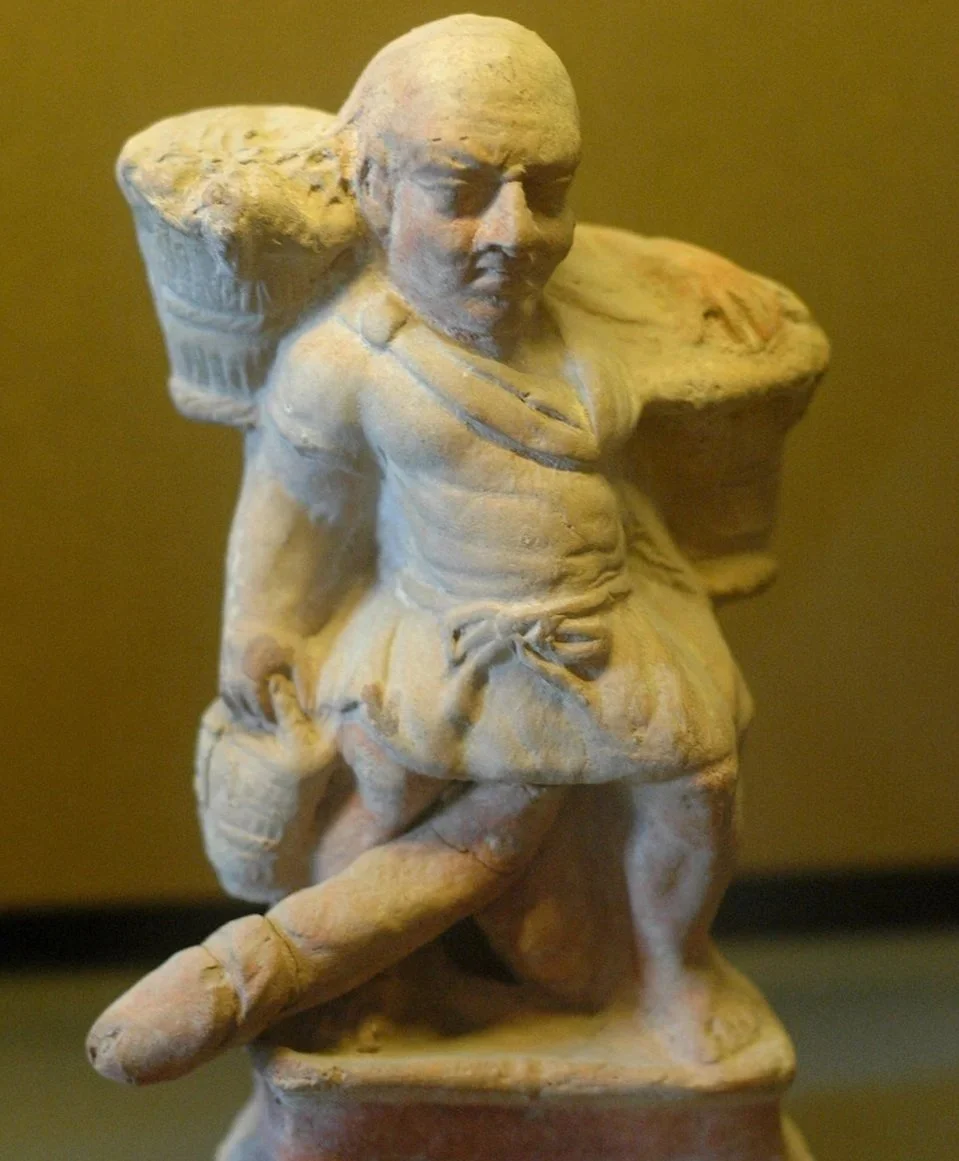
Terracotta figurine of ithyphallic slave (ca. 1st century C.E.), The Louvre, Paris.
Given this widespread exploitation, there is a grim irony in the ribald portrayal of Roman slaves in the surviving literature. In comedies, slaves are often represented as oversexed and licentious, and while the slave-girl Photis in Apuleius’s The Golden Ass complicates the conventional dynamic by exerting power over the free protagonist, Lucius, she is able to do so specifically because of her overt sexualization.
Whose Pleasure Counts?
The Romans were neither the buttoned-up prudes of Victorian imagination nor the debauchees depicted in Caligula and Spartacus: Blood and Sand. They were far more complicated than that. They were a people who talked about sex constantly, wrote about it elegantly, joked about it crudely—and organized it all around a rigorous hierarchy that determined, with unapologetic precision, whose pleasure counted and whose did not.
So what of this would be familiar to us today? The answer likely depends on where you sit in whatever hierarchy governs sex now—and whether or not you have had the misfortune of finding yourself on its lower rungs.