
The Bona Dea Scandal
A reckless young aristocrat, a goddess’s forbidden rites, and a seduction scheme that went spectacularly wrong.
Just about anyone can look back at their high school years and identify that one classmate who made them think: “That person will either be a massive success or end up in jail—and honestly, it could easily be both.”
In Rome of the Late Republic, that person was Publius Clodius Pulcher.
At first glance, Clodius was an entirely conventional nobleman. He was born into an ancient patrician clan, the Claudii, which traced its origins to the murkily remembered days before the founding of the Republic. His ancestors built the first Roman road, fought against the Carthaginians—on one occasion, with almost comically disastrous results (a story for another time)—and opposed nearly every reform measure that reached the Senate floor.
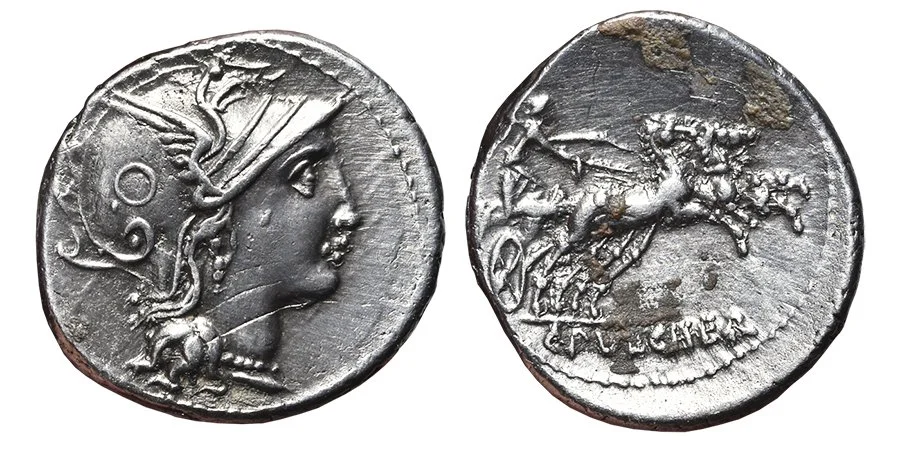
Coin of Appius Claudius Pulcher, father of Clodius, struck 111-110 B.C.E.
Obverse: Helmeted Roma
Reverse: Victoria driving a chariot
The Claudii were famous for their pride, their rashness, and for answering perceived slights with single-minded ruthlessness.
They also had a reputation for courting scandal—oftentimes of a distinctly salacious nature—which provided endless fodder for public gossip.
Clodius inherited all of this—in spades.
Which leads us to the setting of his most notorious exploit.
Bona Dea—the Good Goddess—was a tutelary deity of Roman women, and her cult was one of the rare arenas where women were supreme. Her worship permitted the use of strong wine and blood sacrifice—privileges otherwise denied to women by strict tradition—and her most sacred rites were closed to men. Indeed, so little information about her cult comes down to us—even the true name of the Good Goddess is unknown—precisely because our primary sources were written by men who were not privy to her mysteries.
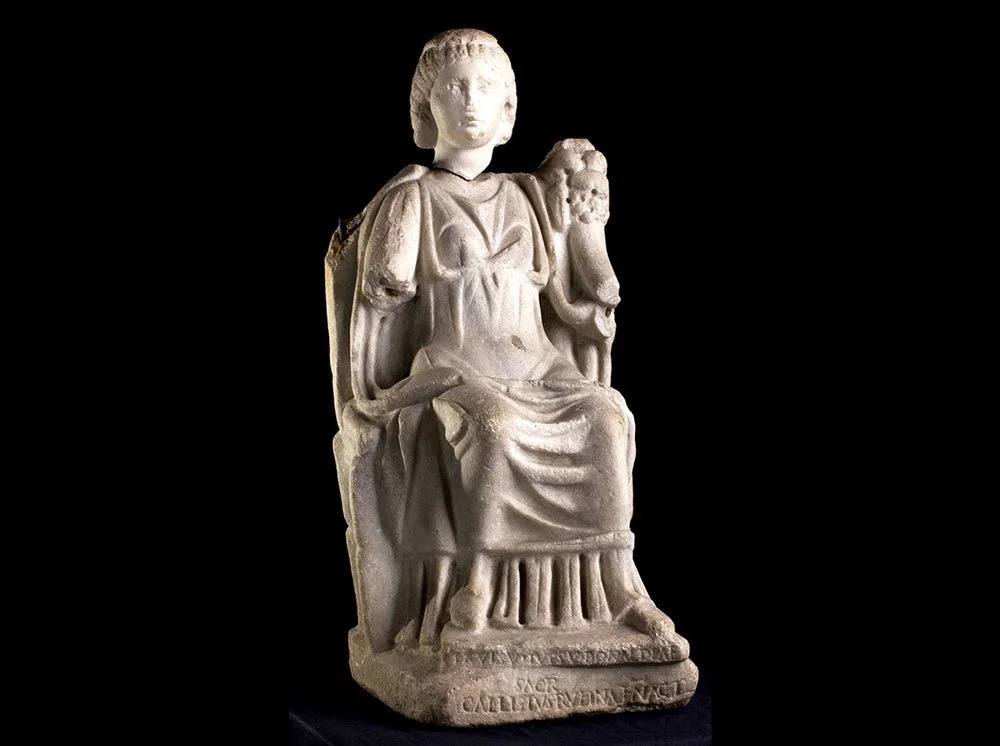
Bona Dea Marble Statue with Epigraph, private collection.
In December of 62 B.C.E., the winter festival of Bona Dea was to be held at the house of Julius Caesar, who had been elected pontifex maximus—chief high priest of Rome—only the year before. Caesar’s wife, Pompeia, and mother, Aurelia, hosted the celebration. They and the Vestal Virgins cleansed the house of all male presence. They decorated with boughs of vines and blooming plants, and laid a banquet table before a couch where the cult image of Bona Dea would recline as an honored guest. It was only after the ritual requirements were fulfilled and darkness fell that Pompeia and Aurelia admitted their guests—the leading women of the city.
The festival continued through the night. Sacrificial wine and the entrails of a sow were offered to the goddess, while the worshippers feasted on more conventional fare. Musicians—all women—raised spirits with the tones of pipes and the strains of lyres. There was dancing and games and ribaldry. The sound of feminine laughter—unleashed by potent wine and uninhibited by male scrutiny—rang out on all sides.
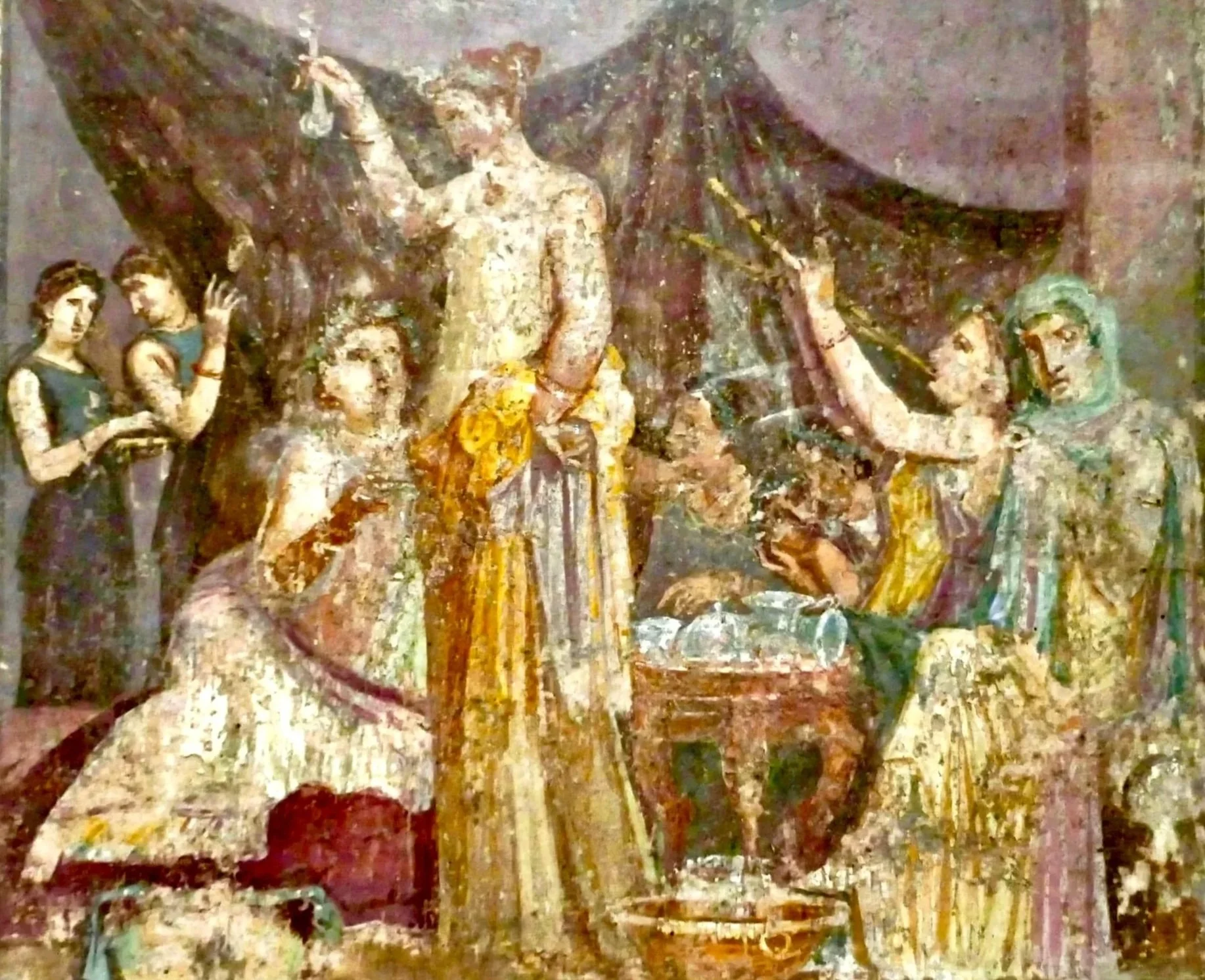
Fresco of a women’s banquet scene from the laundry of Sestius Venustus, Pompeii.
With this much dramatic tension, you just know something will go wrong—and that something was Clodius.
The young nobleman seems to have had designs on Pompeia, and, for reasons known only to him, he decided that the best way to go about seducing her was to infiltrate the feast of Bona Dea. To do this, he disguised himself as a female musician. He donned women’s clothing and procured a harp to complete the guise, trusting in the gloom of night to hide his masculine features—a tenuous, reckless hope given that discovery meant death.
Clodius had a confederate on the inside: Abra, a slave-girl of Caesar’s wife. When he arrived at the house, Abra quickly hid him in a side room so that she might lure Pompeia to her secret suitor. But Clodius, a Claudian to his core, grew impatient. Before long, he decided to go in search of Pompeia himself.
Clodius slunk through the house, skirting knots of merry women and avoiding the light cast by hanging oil lamps. He scrutinized the faces of the women he passed, but Pompeia was nowhere in sight.
A sudden tap on the shoulder. Clodius spun around.
A slave-woman of Aurelia, Caesar’s mother, was regarding him curiously, but without suspicion.
“Why are you wandering like a lost puppy?” she asked. “Come, play us a tune. Join the celebration.”
Clodius, shrinking back into the shadows, hugged the harp to his chest and shook his head.
“Why not?” The slave-woman frowned. “What’s the matter with you?”
When Clodius answered, one would like to imagine that it was in a ludicrously high voice, such as the one that Terry Jones affected in Monty Python’s Life of Brian. Certainly, Clodius’s pretense was no more believable.
Aurelia’s slave gaped at Clodius. And then she screamed.
“A man!” She pointed an accusing finger at Clodius. “There is a man in the house!”
A sudden, terrible silence fell like an executioner’s blade. All eyes were on him.
And Clodius did what any proud, true-born Claudian would do in such circumstances.
He cheesed it.
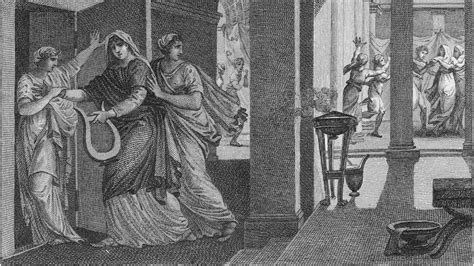
Silvestre David Mirys, illustration of the Bona Dea scandal, from Figures de l'histoire de la République romaine (Paris, 1799–1804).
It must have been an amusing sight—Clodius sprinting through a crowd of shrieking, scandalized noblewomen, fumbling to lift his skirts without losing his grip on the harp—or at least it would have been amusing were the matter not so serious. He had desecrated the rites of Bona Dea and been discovered in the act. His political reputation, not to mention his life, hung in the balance.
It was his misfortune that Caesar’s formidable mother was there.
Aurelia was held in high regard not only for her beauty, but also for her good sense and resourcefulness. While her fellow celebrants panicked, Aurelia leapt into action.
“Bar the doors!” she commanded. “He cannot be allowed to escape. Julia, organize a search party. Pompeia, for the gods’ sake, stop screaming, girl! Pull yourself together and help me!”
Aurelia and Pompeia scooped up the sacred artifacts of the cult and hastened to conceal them from further defilement. The other women, their panic now replaced by outrage, lit torches and fanned out through the house of Caesar in pursuit of the fugitive.
They found him cowering under the bed of the slave-girl, Abra. Few of them were likely to have been surprised when they saw that it was Clodius.
With minimal ceremony—and, one assumes, a well-placed kick or two—they dragged him from the chamber and threw him out the door and into the street. Then, the feast of the goddess thoroughly ruined, the women went home to their husbands and fathers and told them exactly what had occurred.
The ramifications of Clodius’s audacity and sacrilege were sweeping.
Most immediately—and with even less ceremony than the women had employed in ejecting Clodius from the feast—Caesar divorced Pompeia.
There was no evidence that Pompeia had an inappropriate relationship with Clodius, and there was certainly no suggestion that she had any foreknowledge of Clodius’s profane intentions. Caesar was later asked point-blank why, then, had he divorced Pompeia. Caesar famously replied, “Because I thought my wife ought not even to be under suspicion.”
As we saw in a prior entry, Caesar evidently saw no need to hold himself to the same standard of conduct. Given the number of notches on his sword belt, the hypocrisy is frankly stunning.
Clodius was brought up on a charge of incestum—the most dire measure of sacrilege and unchastity—which, as we already saw, carried the death penalty in event of conviction. The prosecution was headed by Clodius’s own ex-brother-in-law, the general Lucius Licinius Lucullus, who had a personal grudge against Clodius—the young man had instigated a mutiny of Lucullus’s army and ruined his command in a highly profitable war—and its star witness was the famous orator, Marcus Tullius Cicero.
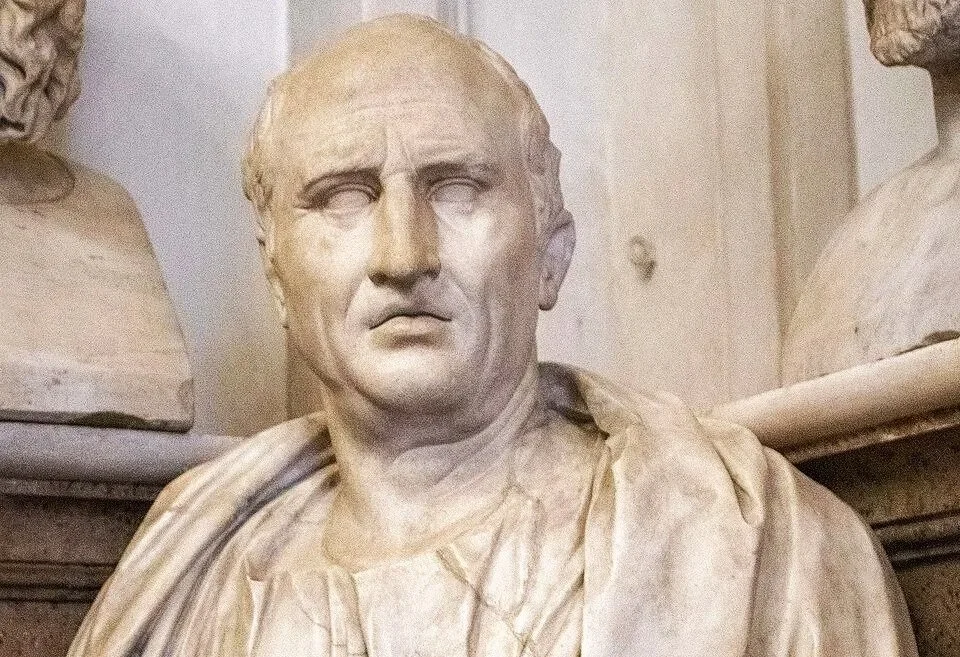
Portrait bust of Cicero (1st century C.E.), Capitoline Museums, Rome.
Lucullus accused Clodius of incest—the word deriving directly from incestum—with his own sister, Lucullus’s ex-wife, and Cicero destroyed Clodius’s alibi on the witness stand. The conservative political establishment smelled blood in the water.
But Clodius defied them all.
Through the pressure exerted on the jurors by the Roman mob—among whom Clodius was very popular—not to mention the judicious application of bribes, he was acquitted of the charge.
And now he had a score to settle with Cicero.
Leveraging his popularity with the poorest Romans, Clodius took the extraordinary measure of having himself adopted by a plebeian, thus shedding his patrician status and enabling him to assume political offices that did not answer to the traditional nobility. From there, he gathered about himself a gang of bullyboys and Forum agitators, who harried and hounded Cicero at every turn. When Clodius managed to have Cicero exiled from Rome, his gang burned down the orator’s home, and Clodius passed a bill consecrating the site for a new temple so that Cicero could never rebuild.
Cicero’s waking nightmare at the hands of Clodius and his thugs only ended when Clodius was murdered in a street fight with a rival gang. But any jubilation derived from the noble rabble-rouser’s death was tempered when his enraged mob set fire to the Senate House, using it as an ad hoc funeral pyre for Clodius.
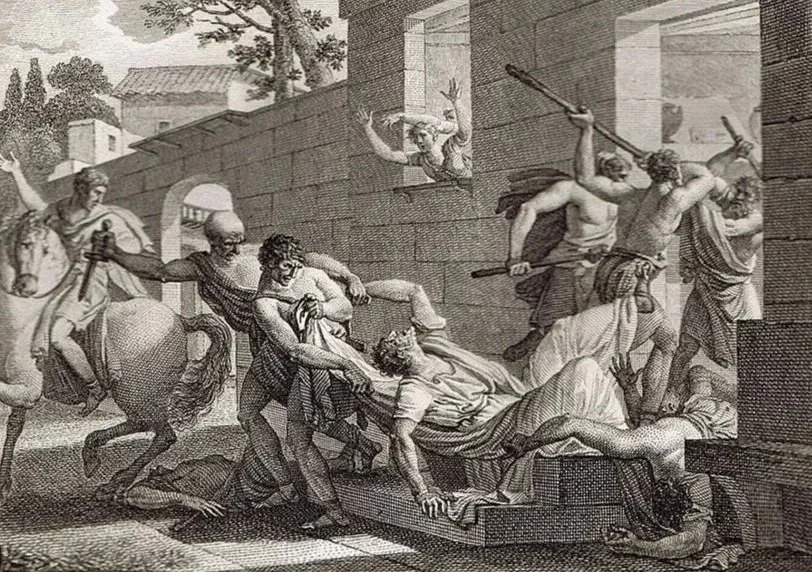
Silvestre David Mirys (des.); Baquoy (grav.), Mort de Clodius, copper engraving, plate no. 155, from the series Rome Antique, Paris, 1810.
History does not record the fate of Abra, Pompeia’s slave and Clodius’s accomplice, but we can safely presume it was not a happy one.
One often overlooked casualty of the scandal was Bona Dea herself.
Clodius’s desecration, not to mention the public scrutiny brought by the trial and the titillating exaggerations that spread about the goddess’s rituals, caused the cult to lapse in subsequent years, or, at most, to continue in a much reduced form.
As part of his program of social and religious restoration, Augustus—Caesar’s great-nephew, adopted son, and spiritual successor—placed his wife, Livia, at the helm of a reinvigorated cult of Bona Dea. But the damage was too great to repair. Even Livia, every bit as formidable as Aurelia—and played sublimely by Siân Phillips opposite Brian Blessed’s Augustus in the BBC Television adaptation of I, Claudius—was unable to restore the goddess to her former prominence. For centuries afterward, the worship of Bona Dea was little more than a punchline about debauched women and cross-dressing men.
Sad results all around. But, given the sheer amount of destruction and disarray that he habitually left in his wake, Clodius probably would have enjoyed knowing that his ill-considered stunt brought down an entire cult.