
Valentinian I: The Emperor Who Shouted Himself to Death
Despite surprisingly progressive public policies, Emperor Valentinian I was often ruled by a violent temper that claimed many lives, including his own.
Autocrats aren’t generally known for their laid-back nature; absolute power tends to attract those willing and able to wield it with ruthless impunity. Still, in a lineup that includes such colorful hotheads as Caligula, Commodus, and Caracalla, Valentinian I manages to stand out among Roman emperors for his complete and utter lack of chill.
Not So Promising Beginnings
Valentinian was born into a military family in 321 and joined the army as a young man. He enjoyed some early successes, but his career was derailed in 357 when he was scapegoated for a rival commander’s incompetence and cashiered in disgrace. Our sources do not state that Valentinian’s rage was fueled by this injustice, but it is safe to assume that it did little to improve his disposition.
Matters worsened when the Pagan Emperor Julian sent the staunchly Christian Valentinian into exile. The sources disagree on the reasons, but the most lively explanation, offered by Sozomen and Theodoret, is that Valentinian, accompanying the emperor on a visit to a temple of Fortuna, was sprinkled with holy water and—perhaps somewhat rashly—responded by bellowing that he had been defiled and punching the offending priest.
If true, this is the first explicit record of Valentinian’s fearsome temper.
In 363, Julian died while on campaign against Persia and was succeeded by the Christian Jovian, who, among other reversals of his predecessor’s policies, recalled Valentinian from exile and restored him to favor. Then, in February, 364, Jovian died in mysterious circumstances that no one seemed particularly interested in investigating, and Valentinian found himself raised to the purple.
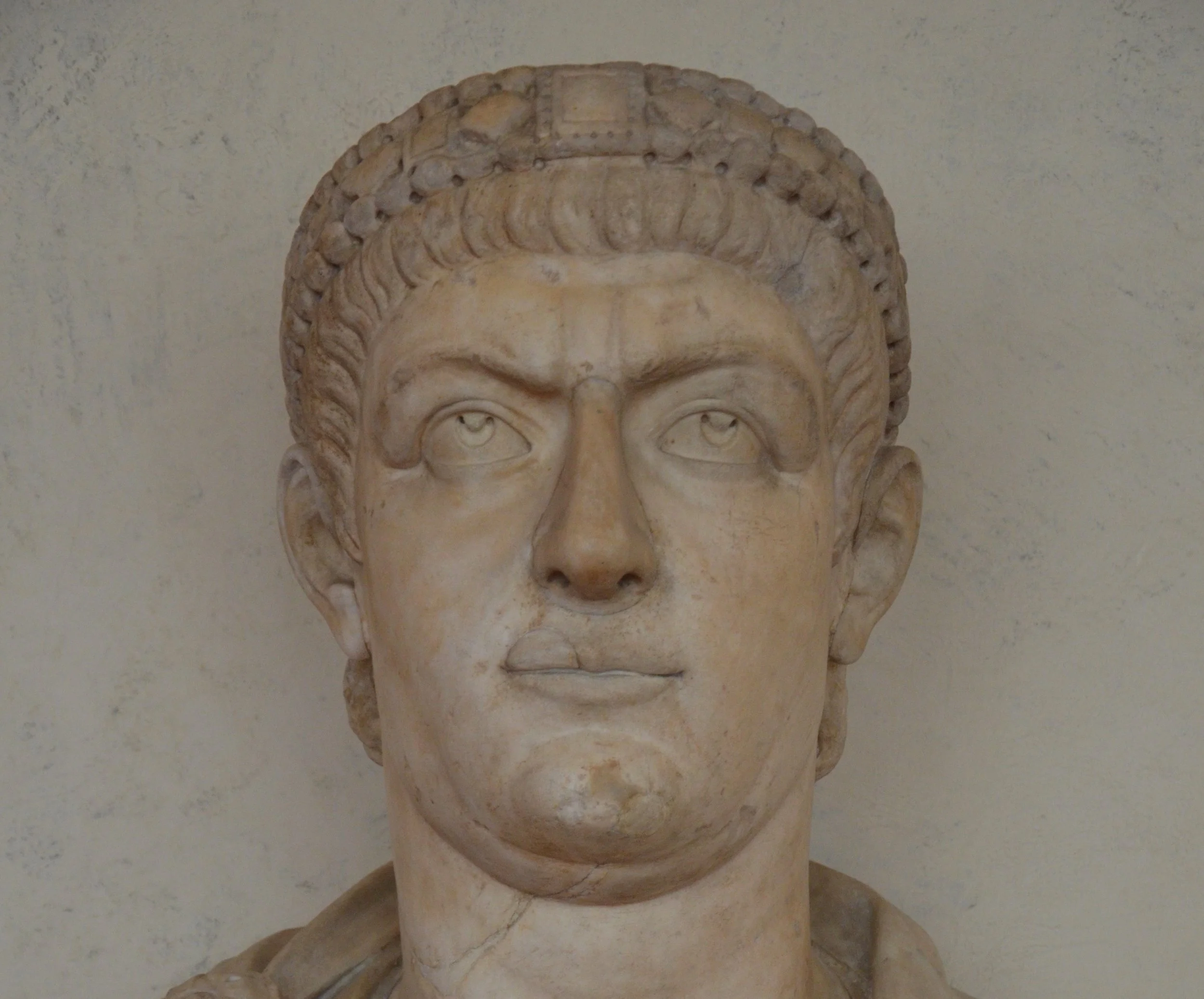
Marble bust of Valentinian I or Valens (ca. 364-378 C.E.), Uffizi, Florence.
The Good
In many ways, Valentinian was a highly effective emperor. At a time when imperial rule necessitated direct involvement in martial affairs, Valentinian was exceptional. Throughout his eleven-year reign, he conducted successful campaigns and stabilized the Rhine and Danube frontiers, which had been in disorder for the better part of two decades. His younger brother, Valens, whom Valentinian made emperor in the eastern half of the empire, had a considerably more checkered military record.
Despite his own fervent Christianity, Valentinian largely maintained a policy of non-intervention in religion. He extended religious freedom to the inhabitants of the empire, including to the sundry Christian sects that had been, and later would be again, subject to persecution. Jews and Pagans were permitted to worship according to their beliefs, although he reinforced previous bans on nocturnal Pagan sacrifices, divination, and magic. Manichaeism, the glaring exception to what was, at the time at least, remarkable liberality, was outlawed as a threat to public order.
He also exhibited an unusual affinity—even among contemporary Christians—for the poor. This perhaps reflected the humble origins of his father, who had reportedly been a rope salesman before enlisting in the army. Valentinian founded schools throughout the empire, and, in an unprecedented move, appointed a physician for each of the fourteen districts of Rome to serve the general populace. He released edicts against the increasing wealth of the Christian clergy, and he tried to shift the burden of taxation away from the lower classes, although these efforts saw only limited and ephemeral success. He also reissued an edict of Constantine I condemning the abandonment and exposure of infants, which doesn’t seem like the sort of thing one would have to do, but there you go…
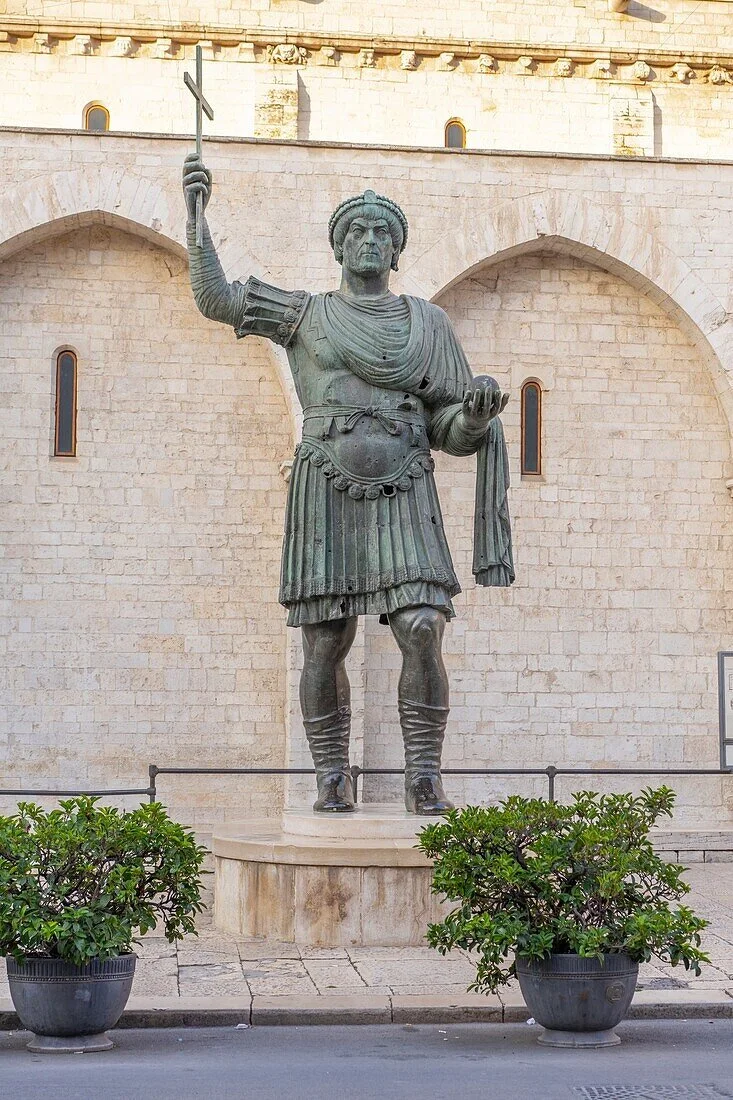
Colossus of Barletta, sometimes associated with Valentinian I (ca. 4th-6th centuries C.E.), Basilica of the Holy Sepulchre, Barletta, Italy.
The Bad and Ugly
But even the most favorable reports of Valentinian’s reign always come back to one thing: he was an unpleasant, brutal, and dangerously temperamental man.
Valentinian was prone to violent outbursts at even the slightest provocation. He ordered slaves, attendants, and even private individuals executed for irritations, minor mistakes, and perceived insults. An imperial page was beaten to death on the emperor’s orders for allowing a valuable Spartan hound to escape during a hunt. On another occasion, the master of a workshop was killed because the exquisitely worked breastplate he brought the emperor was of less weight in steel than Valentinian thought proper.
Valentinian’s penchant for impulsive execution orders was not unique among emperors, but at least one common method certainly was. Valentinian kept two caged she-bears, named Innocence and Gold Flake. Valentinian doted on these creatures, which accompanied him on all of his travels and campaigns. If the historian Ammianus Marcellinus is to be believed, Valentinian was in the habit of feeding victims to them. He was apparently especially fond of Innocence, whom he eventually ordered released into the wild as a reward for her many years of good service.
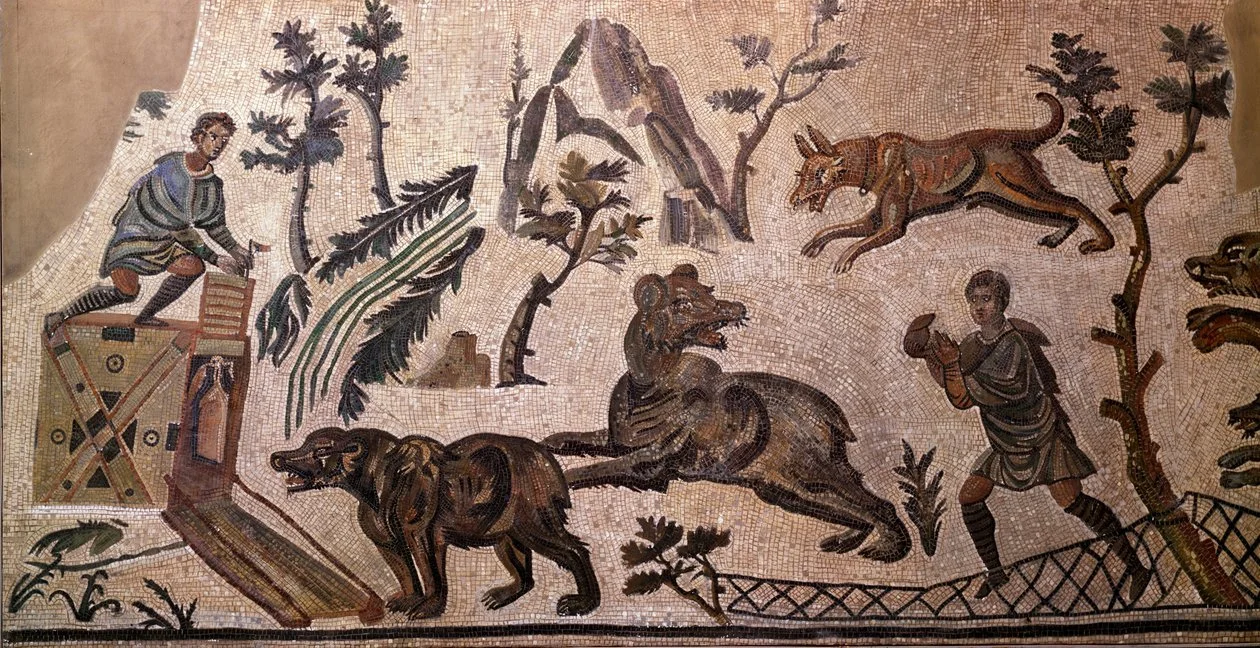
Mosaic of a bear hunt (ca. 4th century C.E.), Museo della Civiltà Romana, Rome.
Even Valentinian’s altruistic impulses appear to have been motivated, or at least counterbalanced, by what Ammianus described as the emperor’s loathing for “the well-dressed and educated and wealthy and well-born.” He both scorned and distrusted the civilian elite of the empire, and when he perceived threats of betrayal, he reacted quickly and ferociously. This instinct was exploited by the same kind of flattering, opportunistic, and corrupt counselors that have always swarmed like flies around despots from Tiberius to Hitler to…well, perhaps better not to keep naming names. Men like the Praetorian Prefect Maximinus and the Master of Offices Remigius used their positions to enrich themselves, and they capitalized on Valentinian’s paranoia and quick temper to have anyone who opposed—or could incriminate—them tortured and killed.
The Poetic Death
In early 374, war broke out with the Germanic Quadi, who lived north of the Danube river in what is today Austria, Czechia, and Slovakia. The inciting event was the planned construction of Roman fortifications on Quadi land, but the proximate cause was the underhanded murder of the Quadi king at a dinner hosted by the local Roman commander—who just so happened to be the son of the Maximinus mentioned above.
After nearly two years of fairly profitless conflict on both sides of the Danube, Valentinian received a delegation of Quadi in Brigetio—modern Szőny in Hungary. The delegation came to negotiate peace, but the parlay went awry almost from the get-go.
There was a set manner in which such affairs were conducted. The Romans were to assume the role of the victorious conqueror; triumphant yet grave, stern yet merciful. The barbarians were supposed to play the conquered; downtrodden, cringing, and impotent.
It did not matter whether or not the Romans had actually won a decisive victory. The Sarmatians, allies of the Quadi, had crossed the Danube, routed two legions, and made off with a magnificent haul in plunder and slaves. And nevertheless, their emissaries had knelt in the mud before Valentinian and begged forgiveness for their actions—and probably got to keep the booty for their troubles.
But the Quadi did not play their assigned role.
The envoys steadfastly—and, for the most part, correctly—insisted that Roman actions had caused this war. They continued to protest encroachments on their territory and condemned the treacherous assassination of their king. They also refused to take responsibility for the actions of rogue bands of Quadi who might still attack the Romans at any time.
And all the while, Valentinian’s broad face grew redder and redder, and the veins in his temples bulged until the diadem felt tight on his head…
Finally, the emperor could take no more. He launched himself from his throne like a ballista bolt and began screaming abuse at the Germans.
He called them insolent, stupid barbarians.
He called them savages and miscreants, unmindful of past kindnesses and ungrateful for his divine forbearance.
He charged them with gross treachery and unmanly deviousness. He threatened their people with utter destruction, extirpation, extermination.
He called them…he called them…
Valentinian faltered. A momentary confusion clouded his eyes, and a distinctly purple hue rose about his mouth and cheeks. Valentinian shook his head as if to clear it and began again to speak, his manner now calmer, his words more gentle. And then, as if struck by a bolt from the sky—to use Ammianus’s phrasing—Valentinian’s voice was choked off and he sagged.
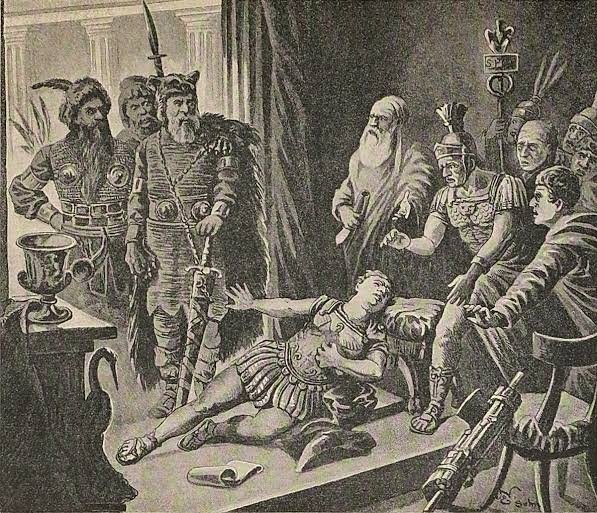
Wilhelm Sohn, illustration of the death of Valentinian I, from Illustrierte Geschichte von Bayern (Stuttgart, ca. 1890).
Slaves leapt forward to catch him so that he would not collapse in full view of the company, and they carried him to his bed-chamber where, after a period of struggle, he died.
Valentinian I, who had lived a life defined by unbridled wrath and rage, had quite literally shouted himself into a fatal stroke.