
Special Edition: America’s Birthday & Rome’s Secular Games
As America marks its 250th, take a look back at how Rome celebrated its own milestones—with sacred rites, dubious math, and one very expensive rhinoceros.
Here in the United States, marching bands and floats crowd the streets and the parks are filled with concert and festival-goers, all in honor of America’s Semiquincentennial. In the midst of these celebrations, naturally, my mind went straight to how the Romans observed significant milestones—because that is the lens through which I tend to view the world.
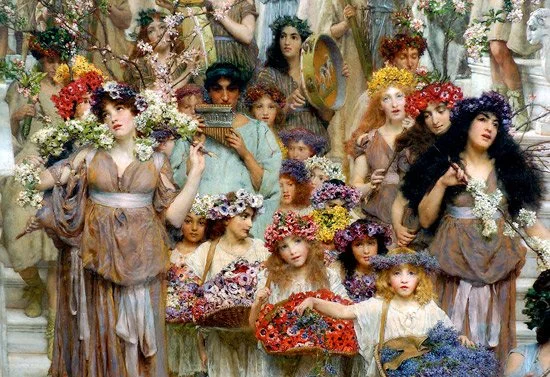
Lawrence Alma-Tadema, Spring (1894), J. Paul Getty Museum, Los Angeles.
Going back at least to the mid-Republic, the Romans observed a cycle of celebrations called the Ludi Saeculares, commonly rendered in English as the Secular Games—a name that erroneously suggests a non-religious character to the festivities, when in fact they were deeply sacred occasions.
The games celebrated the passing of a saeculum, usually translated as ‘age’ or ‘generation,’ and defined as the longest possible length of a human life—one hundred or one hundred ten years. The idea was that when the Secular Games rolled around, there should be no one living who saw the last ones.
Secular Games are directly attested in 249 B.C.E. and in the 140s B.C.E., but they lapsed during the civil wars of the Late Republic. The first emperor Augustus, as part of his program of moral and religious renewal, revived the Secular Games in 17 B.C.E. The three-day extravaganza of sacrifices, theatrical performances, chariot races, and beast hunts was inaugurated by heralds inviting the entire population of Rome to “a spectacle, such as they had never witnessed and never would again.” We are given to understand that they were not disappointed.
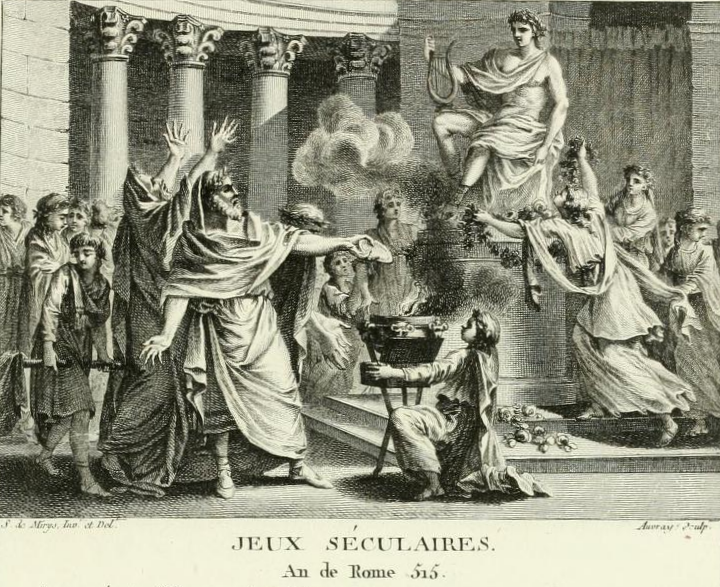
Silvestre David Mirys (des); P.L. Auvray (grav.), Jeux Seculaires, An de Rome 515, plate from Figures de l'Histoire de la République Romaine, (Mirys, Paris, 1800).
The emperor Claudius held his own Secular Games in 48 C.E. in honor of the eight hundredth anniversary of Rome’s founding. This tickled contemporaries, some of whom were old enough to remember Augustus’s Games sixty-five years prior—a suspiciously short interval for an event meant to occur once in a lifetime. But Claudius’s Games created an alternate system of measuring the saeculum, which set a precedent for future emperors to get in on the fun—and bend the calendar to their own PR interests.
In supposed adherence to Augustus’s system, Domitian held Secular Games in 88, followed by Septimius Severus in 204. Between them, in 148—Rome’s nine hundredth birthday—Antoninus Pius celebrated his own Games, which conveniently coincided with the tenth year of his reign.
The most sumptuous—and arguably most propagandistically ambitious—Secular Games were those of emperor Philip in 248, which were held on the occasion of the one thousandth anniversary of Rome’s founding.
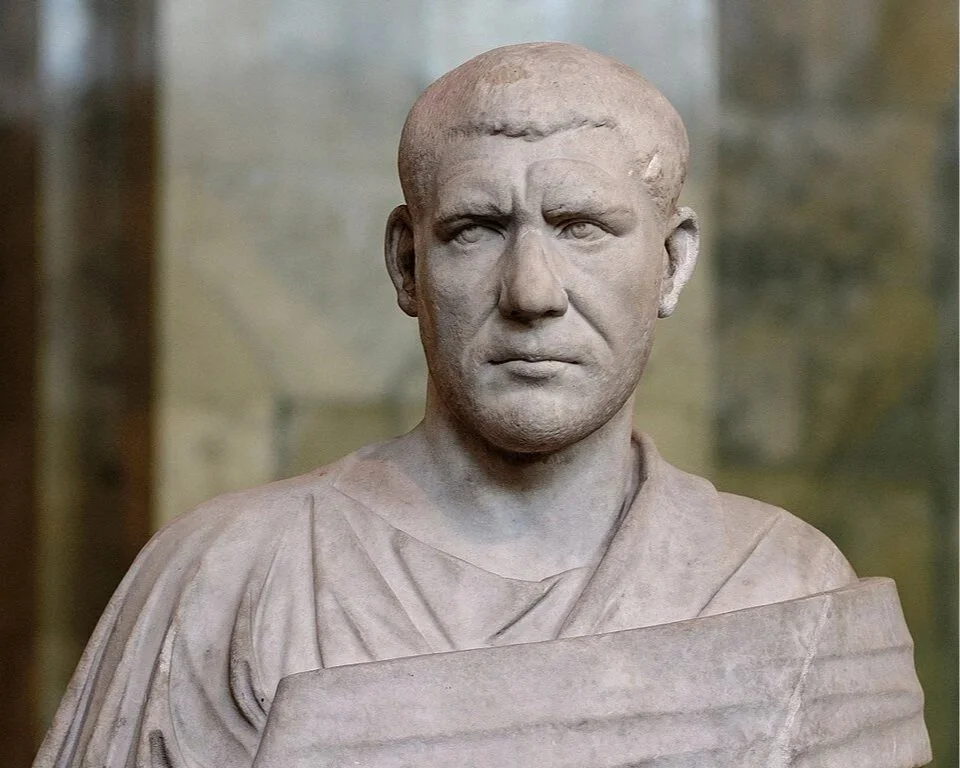
Marble portrait bust of Philip, The State Hermitage Museum, St. Petersburg.
Philip, popularly known as Philip the Arab, came to power during the early stages of Rome’s Crisis of the Third Century, a period characterized by recurrent civil war, foreign invasion, epidemic disease, and economic collapse. He was raised to the throne by the army after the suspicious death of his predecessor, Gordian III, for whom Philip served as Praetorian Prefect—as we saw in a prior entry, the holder of this office could sometimes be of dubious reliability.
Philip needed to legitimize his reign, establish his dynasty, and stabilize the political situation in Rome. In the Secular Games, he saw the ideal instrument to accomplish all three.
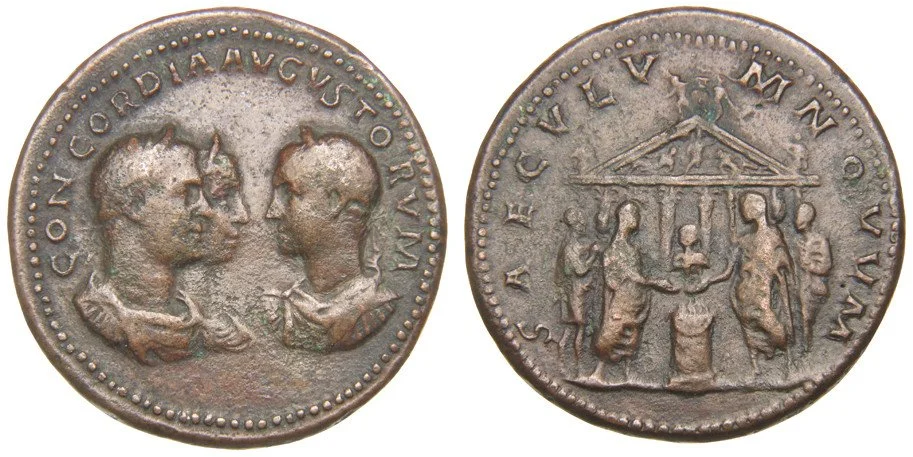
Bronze commemorative medallion of Philip, struck 247-248.
Obverse: Busts of Philip I, Otacilia Severa, and Philip II, legend HARMONY OF THE EMPERORS
Reverse: Sacrificial scene, legend NEW ERA
So, to paraphrase Jurassic Park’s John Hammond, Philip spared no expense.
All of Rome became the stage for Philip’s grand exhibition. Lavish theatrical productions unfolded throughout the city. Exotic beasts in their hundreds—including lions, leopards, elephants, hippos, and, most impressively, a rhinoceros—were slaughtered in the arena by specialized beast hunters. Sources claim that one thousand pairs of gladiators engaged in mortal combat—remarkable because gladiators were expensive to train and keep, and their bouts typically did not end in death. A series of chariot races with grand victor’s purses capped off these monumental Games.
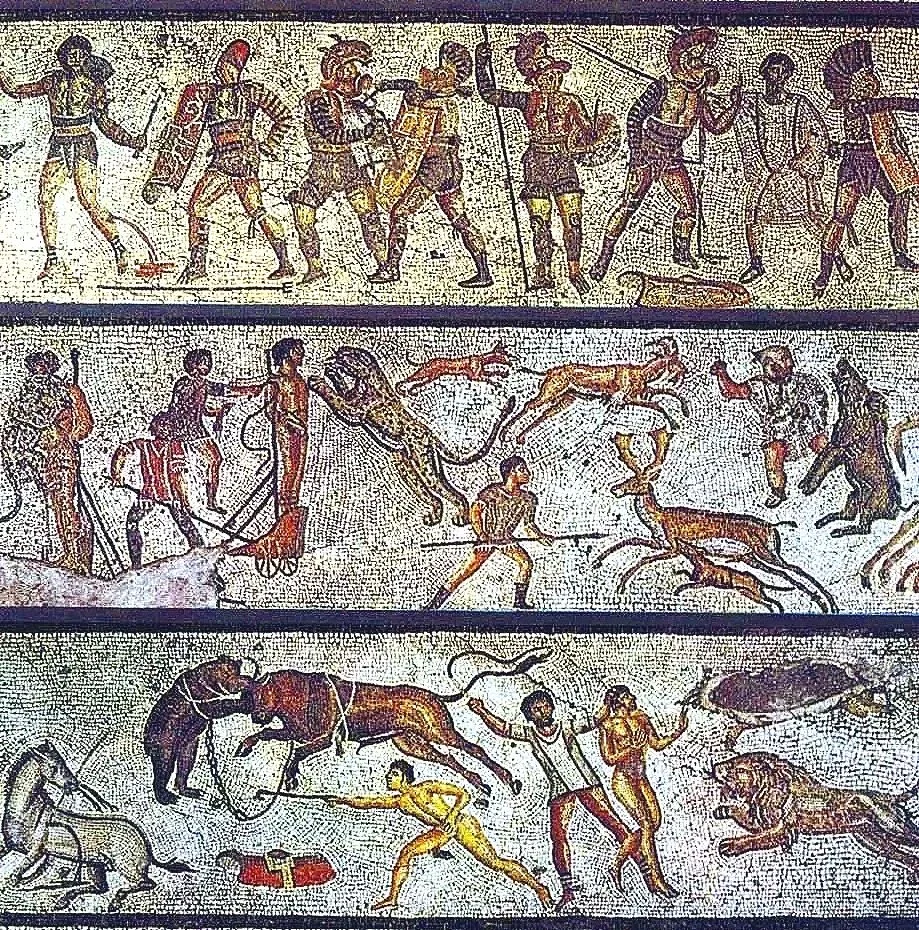
Zliten Mosaic (ca. 2nd century C.E.), The Archaeological Museum of Tripoli, Tripoli.
Philip took full advantage of the good feeling and positive publicity his Games generated—or at least he tried to.
He seized the occasion to elevate his young son, Philip II, to the rank of co-Augustus. He also issued a new series of coins in commemoration of his Secular Games—just in case anyone wasn’t aware of who had put them on.
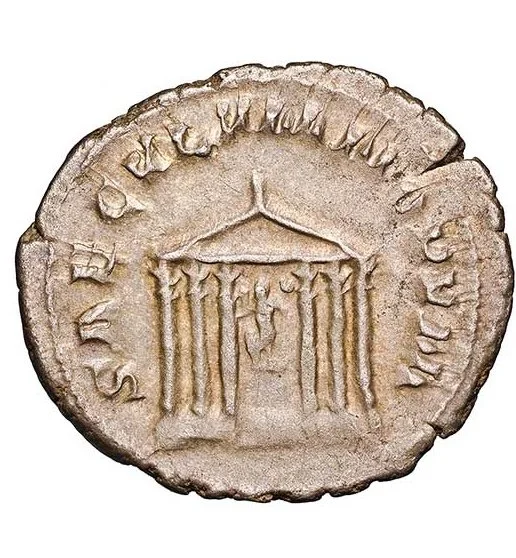
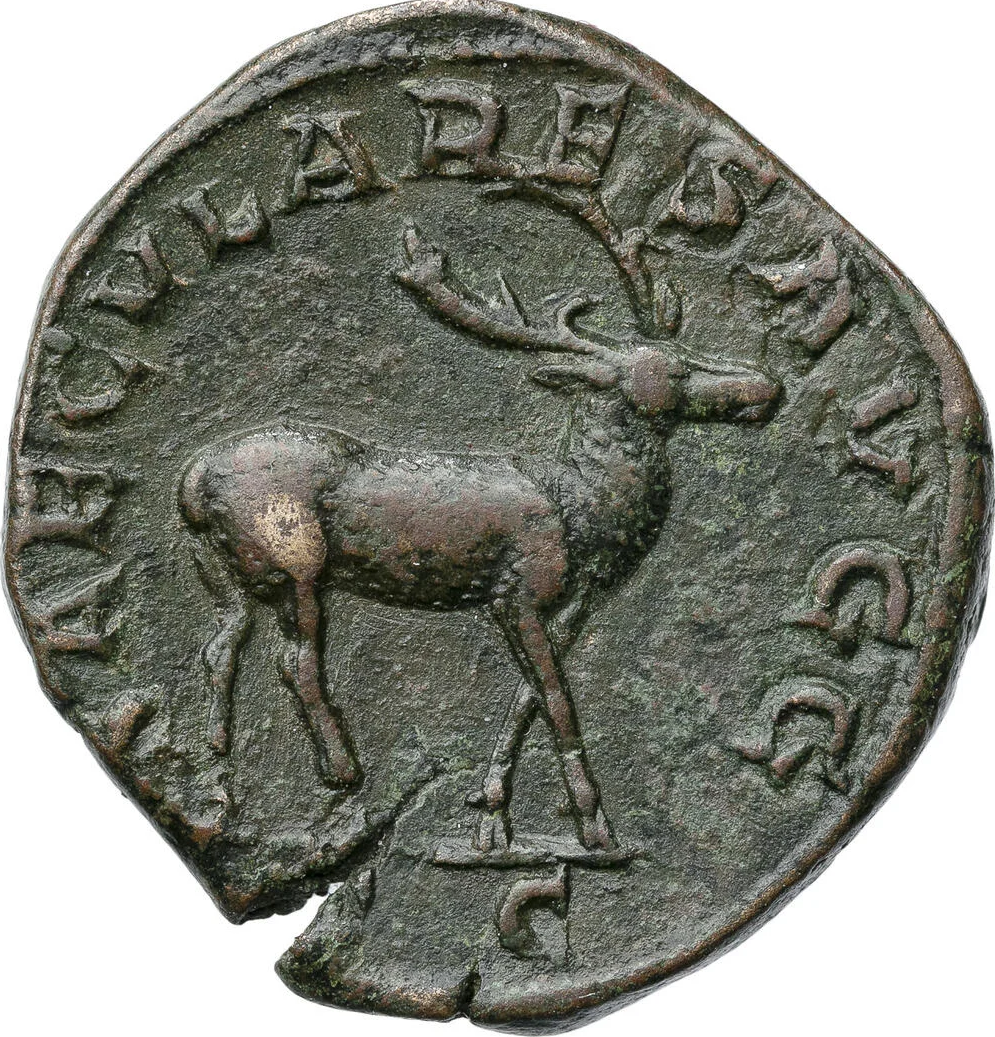
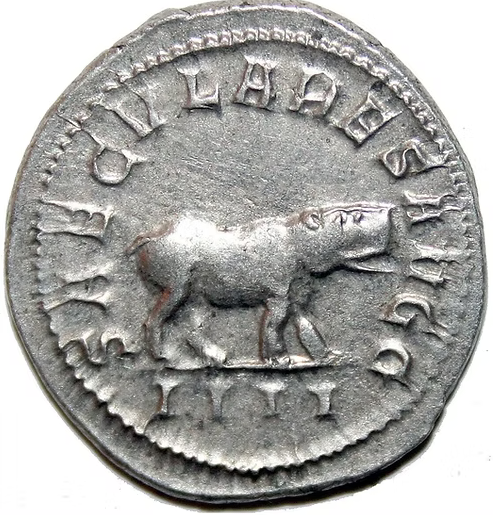
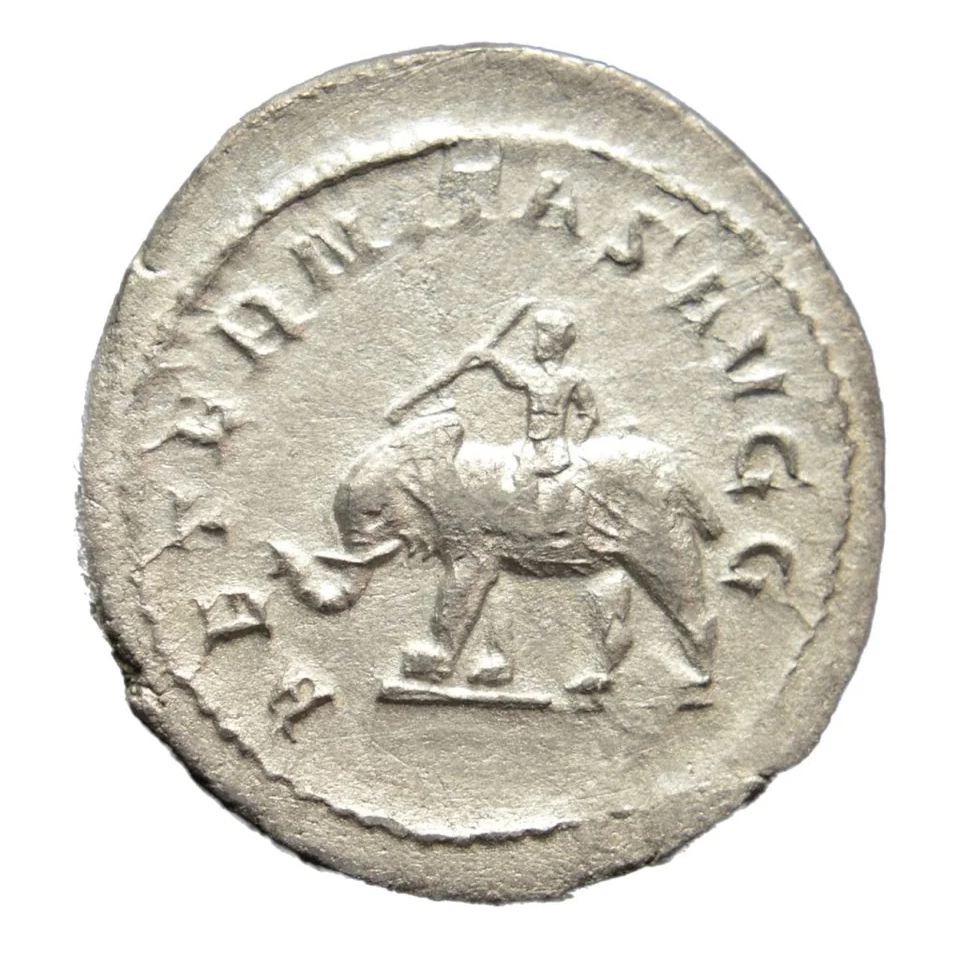
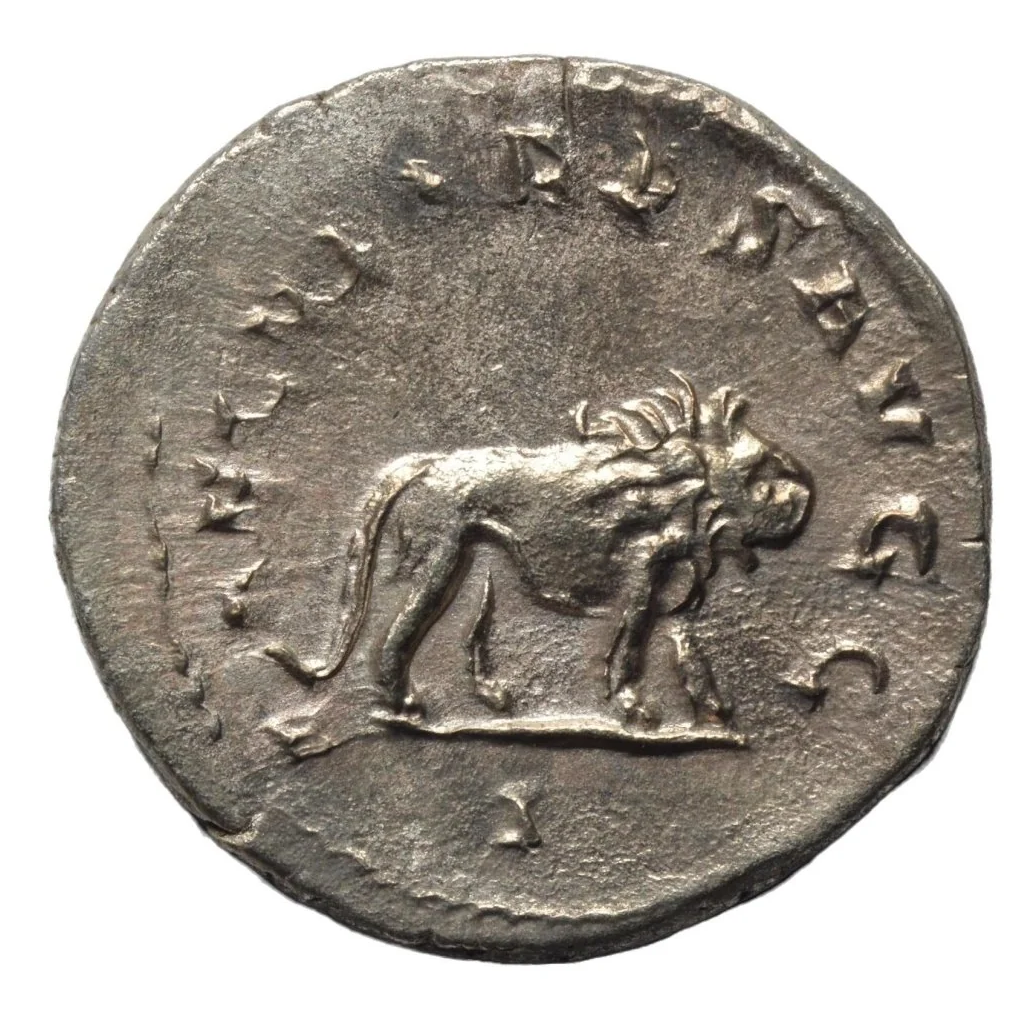
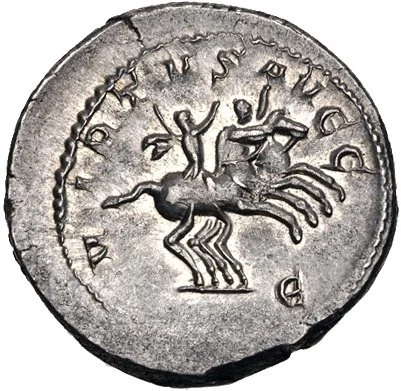
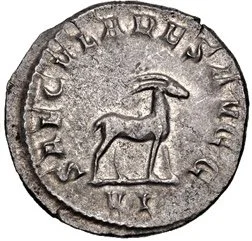
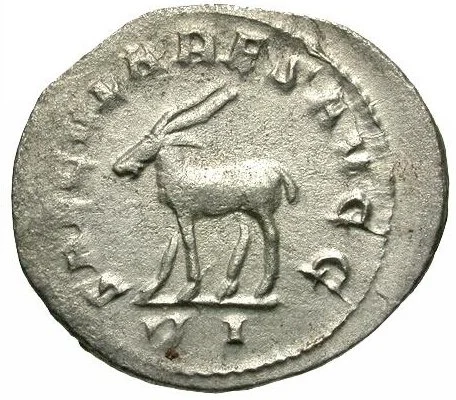
There is a degree of irony in this, given that the Games placed an unsustainable strain on the empire’s already depleted coffers.
Unfortunately for the two Philips, these spectacular and ruinously expensive Secular Games were not enough. They were overthrown and killed by a usurper within the year, and Rome’s period of crisis only escalated in scale and intensity.
In composing this special edition post, I kept looking for some deeper relevance or lesson to draw from all this—something more than ‘milestones invite spectacle.’ The best I have come up with is: for all that our society draws inspiration from the Romans—and in spite of whatever else divides us—we can all agree that America’s two hundred fiftieth would not be improved by the dubious entertainment value of men and animals being forced to fight to the death.
At least I hope we can all agree on that…