
Unlucky in Love: Claudius & His Four Wives
Henry VIII might edge out Claudius on sheer volume, but the antics of Claudius’s wives would have sent the Tudors running to therapy.
As we saw in a previous entry, the emperor Claudius lived a life largely devoid of love and affection. A childhood illness left him with a lifelong limp, tremor, and stutter, which led his contemporaries—and even his family—to dismiss him as an invalid and an idiot.
And yet, as a member of the imperial family, there were still certain expectations of him. One was to marry and produce children to bolster the Julio-Claudian dynasty, which had a habit of losing members to exile, execution, and premature death.
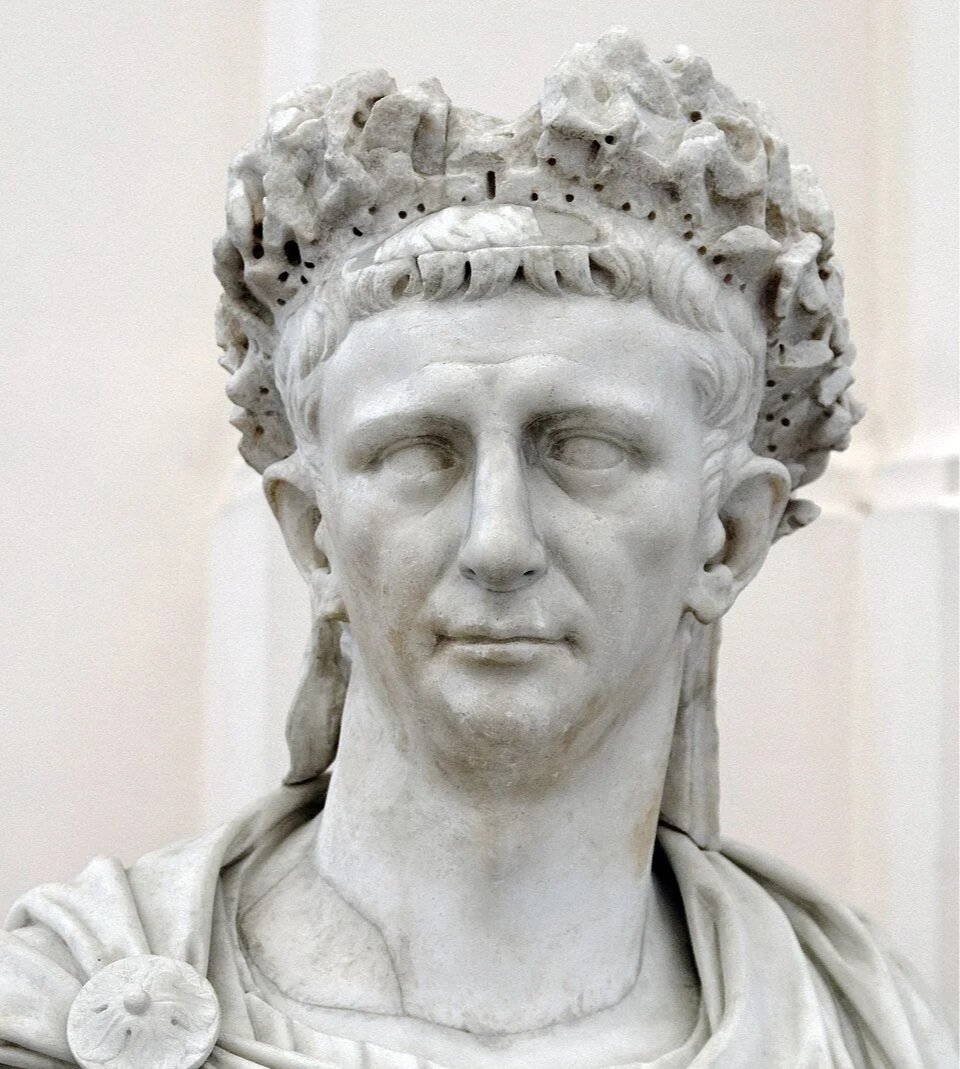
Marble bust of Claudius (ca. 41—54 C.E.), Museo Archeologico Nazionale di Napoli, Naples.
Unfortunately for Claudius, his four attempts at matrimony went rather badly—even by Julio-Claudian standards.
A Rather Unpromising Prologue
Before we dig into Claudius’s first marriage, we should briefly touch on two prior, failed betrothals.
His engagement to Aemilia Lepida was dissolved when her family fell out of favor with Augustus, and Livia Medullina Camilla seems to have died suddenly on the wedding day.
As we’ll soon see, the old axiom that a bad dress rehearsal leads to a splendid opening night did not apply to Claudius.
Wife #1: Plautia Urgulanilla

Woodcut of Plautia Urgulanilla from Guillaume Rouillé, Promptuarii Iconum Insigniorum, (Lyon: Guillaume Rouillé, 1553).
Claudius was wed to Plautia Urgulanilla in 9 C.E. at the age of eighteen. His wife’s grandmother was a close friend of Livia, Augustus’s wife and Claudius’s grandmother, which was probably a decisive factor in obtaining a bride for the unprepossessing young man after the two prior false starts.
The sources suggest that the relationship was highly turbulent. There is little reason to doubt that Urgulanilla shared the same low opinion of her husband as everyone else, and she had at least one well-known affair with a certain Boter, a freedman and secretary to Claudius.
Their fifteen-year union produced a son, Claudius Drusus, who died in a freak accident as a youth—he apparently choked on a pear he was attempting to catch in his mouth.
In the year 24, Urgulanilla’s brother was accused of murdering his wife by throwing her from a window, and Urgulanilla herself was implicated, perhaps unjustly. It is likely that Claudius’s wife was shielded from prosecution by the influence of Livia, but Claudius nevertheless took the opportunity to rid himself of her.
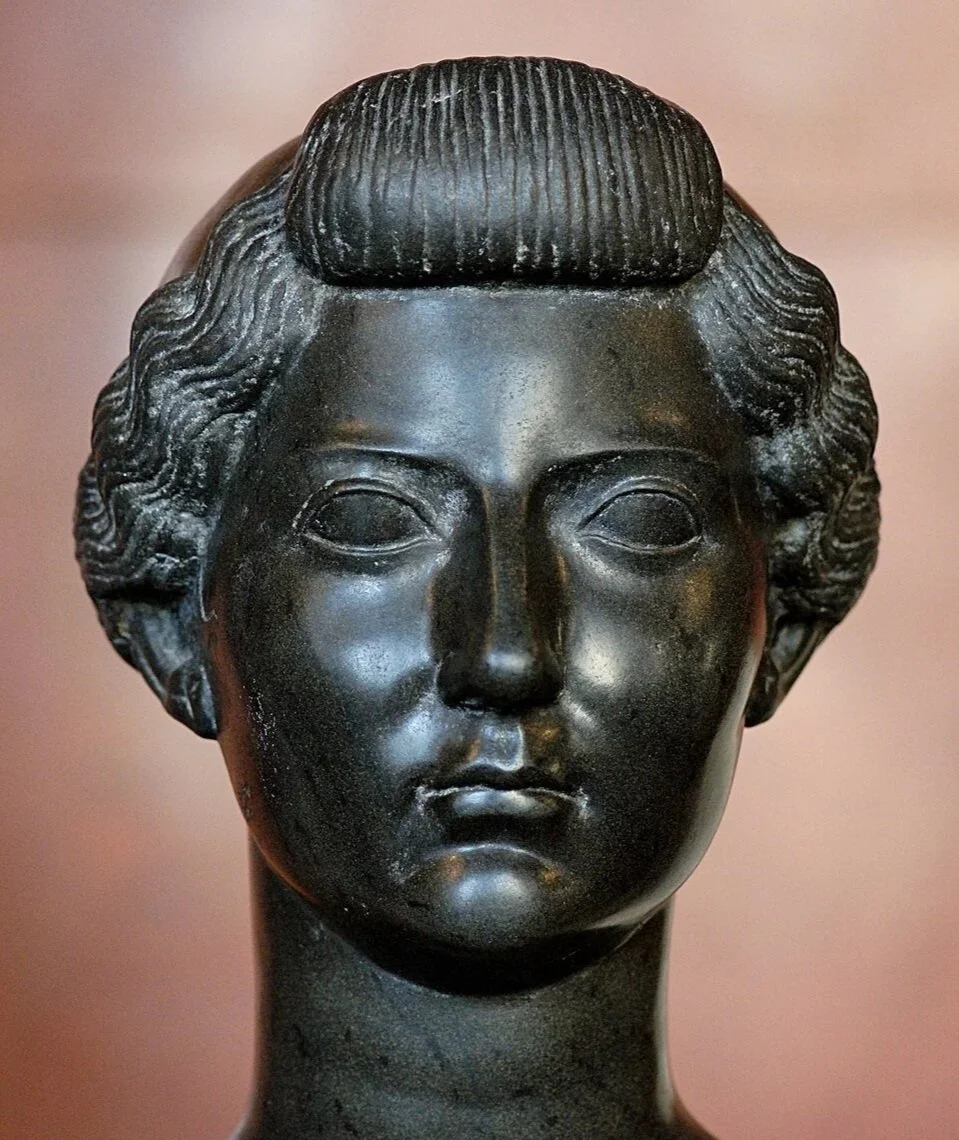
Basalt bust of Livia (ca. 31 B.C.E.), The Louvre, Paris.
He divorced Urgulanilla—citing conspiracy to murder and infidelity—and when she gave birth to a daughter five months after the divorce, Claudius publicly repudiated the child, claiming she was fathered by Boter.
As an aside, it seems likely that Boter came to a rather nasty end for sticking his nose—and apparently other parts of himself—where they did not belong.
Wife #2: Aelia Paetina
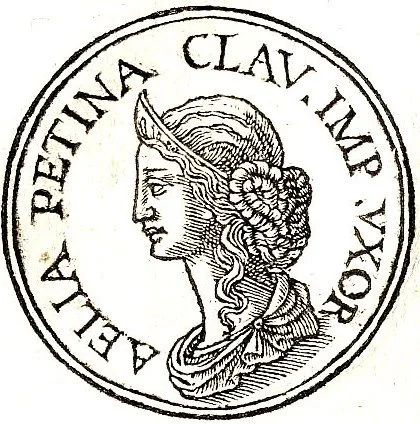
Woodcut of Aelia Paetina from Guillaume Rouillé, Promptuarii Iconum Insigniorum, (Lyon: Guillaume Rouillé, 1553).
In 28, Claudius married Aelia Paetina, the adoptive sister of Lucius Aelius Sejanus, who was praetorian prefect to the emperor Tiberius, Claudius’s uncle. As with Urgulanilla, there seems to have been little love lost between Claudius and his second wife.
Coldness aside, this was another less-than-stellar match for Claudius, as Paetina was raised in an equestrian, rather than a senatorial, family. It appears that this was a way for Tiberius to sacrifice an unimportant relation in order to show favor to Sejanus, whom Tiberius fondly called “the partner of my labors” and upon whom he came to rely for almost every aspect of imperial governance while he secluded himself on the isle of Capri.
As it happens, Sejanus was less devoted subordinate than cunning opportunist, and Paetina’s marriage was just one more component of the springboard he was erecting to launch his secret imperial ambitions.
Sejanus’s perfidy was uncovered in October of 31, which led to a great deal of unpleasantness for him, his family, and his close associates that we won’t address here.
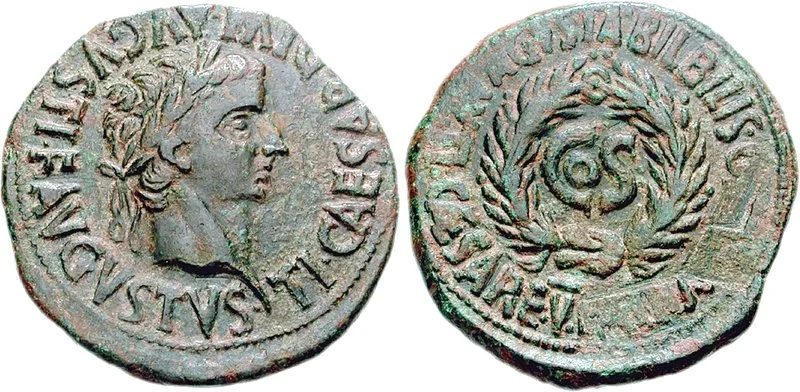
Coin from Augusta Bilbilis minted in the name of Tiberius (obverse) and Sejanus (reverse), ca. 31 C.E.
Sejanus’s name has been abraded.
Paetina got off fairly easily, in that her corpse wasn’t left exposed on the Gemonian Stairs with the rest of Sejanus’s associates. Claudius simply divorced her, which was surely the least of her problems. Suetonius writes that he gave trifling reasons for the dissolution of the marriage—it has been suggested that she was rather cruel to Claudius—but it seems likely that Claudius was eager to separate from a spouse who had suddenly become a potentially lethal political liability. Their daughter, Claudia Antonia, was put to death by Nero in 66.
Wife #3: Valeria Messalina
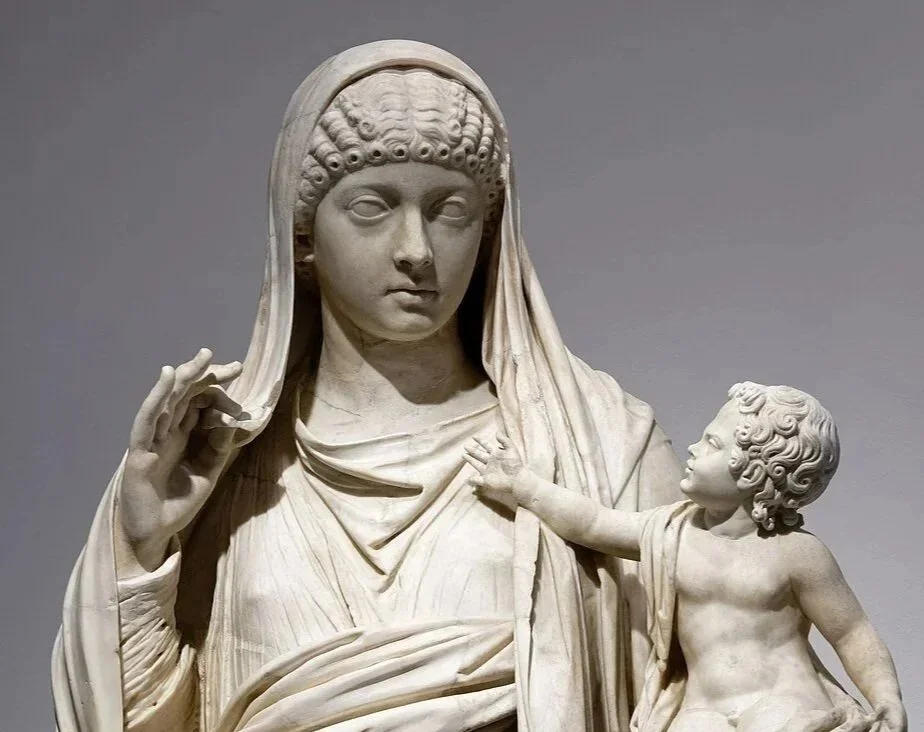
Marble statue of Messalina with son, Britannicus (ca. 45 C.E.), The Louvre, Paris.
Claudius’s third marriage was to Valeria Messalina, the bearer of a proud senatorial lineage and a not-too-distant cousin to the Julio-Claudians. When they wed in 38, Claudius was forty-seven and Messalina was between fifteen and eighteen, and when Claudius was proclaimed emperor in 41, Messalina became empress.
Unlike Urgulanilla and Paetina, Claudius appears to have been devoted to Messalina—much to his eventual regret.
Now, it must be said that history has been extraordinarily unkind to Claudius’s third wife. The surviving sources were all written well after her death and under a new imperial dynasty whose messaging sought to undercut and delegitimize the Julio-Claudians. For that reason, modern scholars have grappled with the image of the cruel, manipulative, predatory, and almost unimaginably lascivious Messalina that has come down to us.

Peder Severin Krøyer, Messalina (1881), Gothenburg Museum of Art, Gothenburg.
She has been accused of persecuting—through her deft manipulation of Claudius—multiple members of the imperial family and of the senatorial aristocracy, many of whom were exiled or executed. The motives for these actions vary from rivalry to avarice to, in the case of at least one senator, his refusal to sleep with her.
And it is her supposed sexual history that has most captured the imagination of posterity. She is alleged to have had countless affairs behind Claudius’s back, with lovers ranging in status from high-born senators to common plebs and even actors—Rome’s lowest of the low. Aurelius Victor claims that she amassed upwards of one hundred and fifty lovers.
Perhaps the most salacious story concerns a sex competition she staged against a well-known and highly accomplished prostitute. The competition reportedly lasted a night and a day, and Messalina prevailed with twenty-five partners. Many of these details—the promiscuity in general and the sex-a-thon in particular—have come to be viewed with well deserved skepticism.
What has gained broad acceptance among historians, however, is that Messalina was a ruthless and savvy operator, who jealously guarded the position of her children by Claudius, Claudia Octavia and Britannicus. What is also generally regarded as true is the cause of her downfall.
In 48, Claudius traveled to Ostia to tour a new harbor construction. In his absence, Messalina and her lover, the prominent senator Gaius Silius, brought their affair into the open in a most spectacular fashion: they held an opulent wedding banquet attended by some of Rome’s leading aristocrats and in full view of the citizenry.
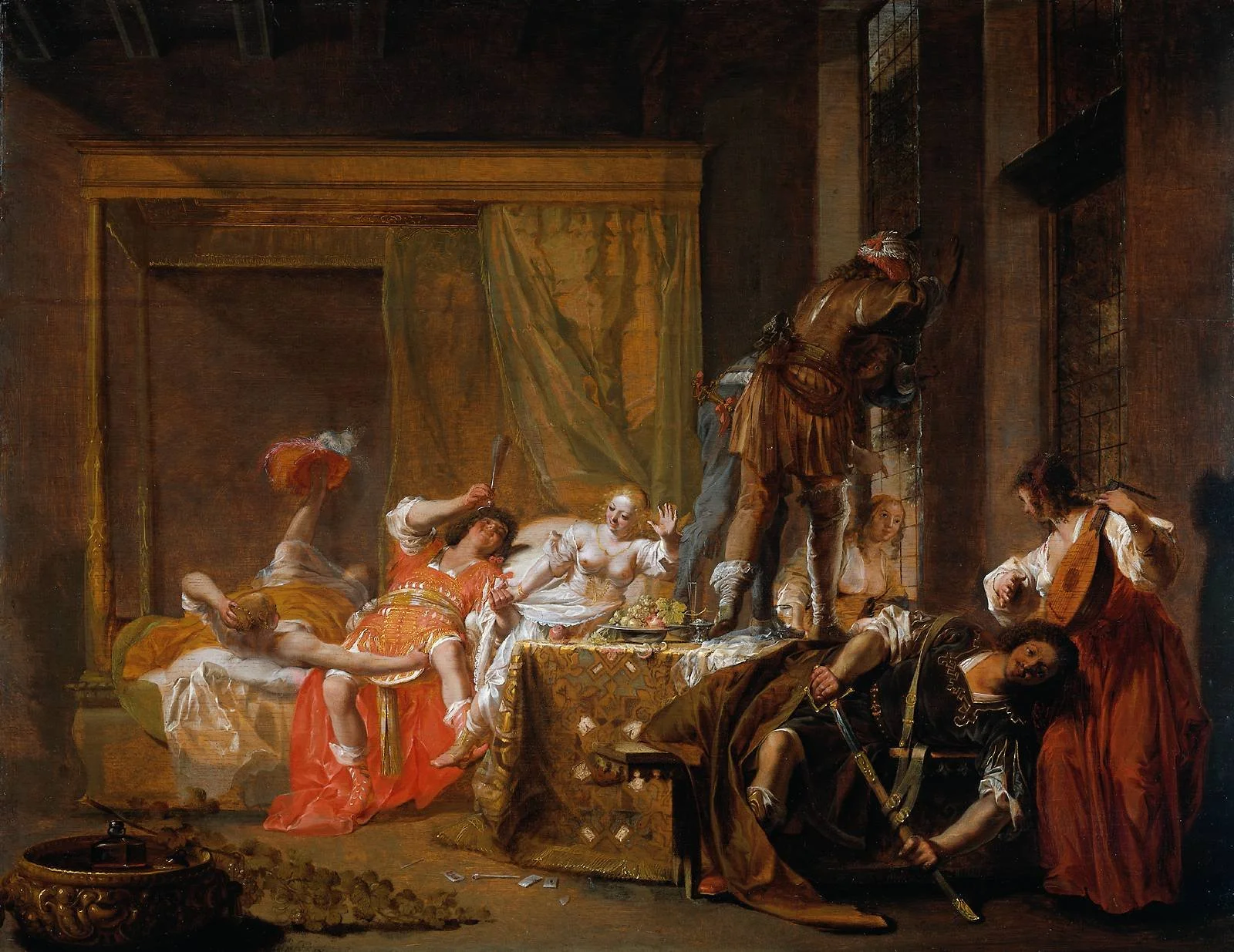
Nikolaus Knüpfer, Scene from the Wedding of Messalina and Gaius Silius (ca. 1650), Rijksmuseum, Amsterdam.
Whether this was a genuine attempt to seize the throne from Claudius or merely a sham wedding driven out of control by an excess of wine and the habit of impunity, the result was the same.
Claudius hurried back to Rome in a towering rage. Silius and perhaps as many as one hundred others were arrested and executed. But despite the mounting evidence of Messalina’s betrayals, Claudius’s feelings began to soften, and he asked to see her the next morning.
One of the emperor’s freedmen decided to take matters into his own hands. Pretending to act on Claudius’s orders, he instructed an officer of the Praetorian Guard to execute Messalina. She was offered the chance to take her own life—generally considered by the Romans to be the more honorable route—but when she could not work up the resolution, the guardsman did it for her.
Tacitus reports that Claudius never showed any emotion in the aftermath of Messalina’s death. The historian suggests that this was the result of senility and drunkenness; a more generous interpretation might be a profound, inescapable, and entirely understandable melancholy.
Wife #4: Julia Agrippina
One would be forgiven for thinking that Claudius might have given up on the whole marriage thing after Messalina, but alas, no. Perhaps he imagined that it would go better if he looked closer to home.
His fourth wife, Julia Agrippina, was twenty-five years his junior and his niece—which was exactly as shocking and, frankly, gross to the Romans as it is to us.

The Gemma Claudia, a five-layered onyx cameo (ca. 49 C.E.), Kunsthistorisches Museum, Vienna.
Claudius and Agrippina are depicted on the left. Agrippina’s parents (and Claudius’s brother and sister-in-law), Germanicus and Agrippina the Elder are on the right.
Agrippina was just one prospect among several—including Aelia Paetina for a proposed second round—put forward by the emperor’s various advisors, but Agrippina’s candidacy was successfully shepherded by Pallas, Claudius’s advisor and, reportedly, Agrippina’s lover.
They were married in the year 49 to broad disapproval, and Agrippina wasted little time in securing the prospects of her son from her first marriage, Lucius Domitius Ahenobarbus.
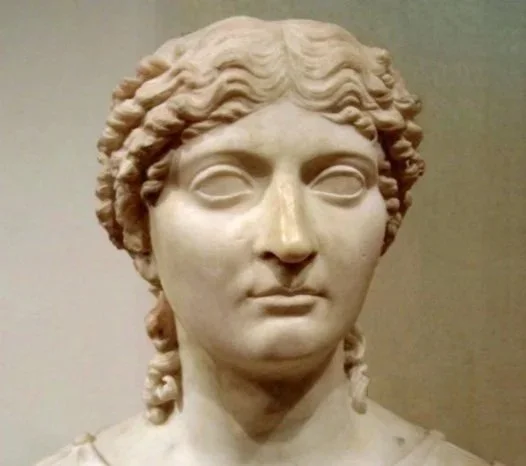
Marble bust of Julia Agrippina (ca. 50—54 C.E.), National Museum, Warsaw.
Agrippina quickly cemented her position at court. She made herself an indispensable resource to Claudius and came to wield tremendous influence over him. This allowed her to do away with all impediments to her authority—ruthlessly and, not infrequently, bloodily—and to position Ahenobarbus as heir apparent. This made a degree of sense, as Agrippina’s son was four years Britannicus’s senior, and Claudius’s advanced age underscored the urgent need for a mature successor.
Within the year, Claudius adopted the twelve-year-old Ahenobarbus, who took on the name Nero. Two years later, in 53, Nero was married to Claudius’s daughter by Messalina, Claudia Octavia—and all the while, Agrippina gradually isolated Britannicus.

Marble statue of Nero (ca. 50 C.E.), Detroit Institute of Arts, Detroit.
Our sources report that Claudius began to recognize the threat that Agrippina and Nero posed—and moved to protect Britannicus’s prospects—but by then it was too late.
In October 54, at the age of sixty-three, Claudius died. If the ancient historians are to be believed—and on this score, they are just about unanimous—his death was brought about by poison at the instigation of Agrippina and concealed in his favorite mushroom dish.
As with the ancient consensus on Messalina, modern historians hotly debate Claudius’s cause of death. Several have called the traditional narrative into question, pointing to Claudius’s age and declining health. But, then again, Agrippina had both motive—with her control total and Nero’s position assured, there was little reason to keep Claudius puttering around until Britannicus came of age—and opportunity, and the unanimity of the sources is hard to ignore.
And as if there wasn’t enough sorrow to be going on with, Claudius’s children fared about as well under Nero as you might expect. Britannicus, who should have been his father’s successor, was poisoned within months of Claudius’s death. Claudia Octavia survived for some time as Nero’s wife—until he grew bored of her and had her shipped off to a discreet island and murdered out of the public eye.
Summing Up
Even with the uncertainty—and, at times, dubiousness—of the ancient sources we are forced to rely upon, it is hard to imagine a more uniformly depressing matrimonial line-up than that of the emperor Claudius:
Plautia Urgulanilla, cold, disloyal, and an accused murderess.
Aelia Paetina, possibly cruel, and both foisted on him and discarded out of political necessity.
Valeria Messalina, manipulative, unfaithful, and treacherous.
Agrippina, the imperial cuckoo, who supplanted Claudius’s son with her own, and may well have brought about the emperor’s death.